

Particle Concentration Measurement
Multiparametric particle characterization for formulation development, stability assessment and quality control
Cosmetic and personal care products are often complex mixtures rather than simple homogeneous liquids. Creams, lotions, sunscreens, make-up, serums and other formulations may contain droplets, pigments, mineral particles, encapsulated ingredients or dispersed functional materials. The way these populations are distributed can influence appearance, texture, stability and product consistency.
Particle analysis provides a practical way to understand this complexity. Size distribution is important, but it is only part of the picture. Two formulations can have similar average particle sizes while differing in particle concentration, population heterogeneity or optical properties. These differences can become relevant during formulation development, scale-up, storage and quality control.
Multiparametric single-particle analysis adds information beyond a conventional size measurement. By examining individual particles and combining size-related data with concentration and optical characteristics, it becomes possible to describe heterogeneous cosmetic formulations in greater detail and to follow changes that may otherwise remain hidden in an average value.
AN020 – Multiparametric analysis of particles in toothpastes: https://www.eosinstruments.com/an020-multiparametric-analysis-of-particles-in-toothpastes/
Why Particle Characterization Matters in Cosmetics
The physical organization of a cosmetic formulation is closely linked to how it behaves. Dispersed particles and droplets can influence visual uniformity, sedimentation, phase stability and the consistency of the final product. Their behaviour can also change when ingredients, processing conditions or storage environments are modified.
During product development, formulators may need to compare several prototypes that differ only slightly in composition. A change in emulsifier, thickener, pigment concentration or processing step can alter the particulate structure of the formulation. Particle characterization helps make these differences measurable and provides data that can support formulation decisions.
The same approach is useful after a formulation has been selected. Measurements performed during stability studies, process optimization or batch comparison can show whether the expected particle populations remain consistent or whether new populations appear over time.
The Analytical Challenge: Real Cosmetic Formulations Are Heterogeneous
Many cosmetic products contain several dispersed components at the same time. A coloured formulation may include pigment particles together with droplets and other suspended materials. A sunscreen can contain dispersed particulate ingredients within a complex continuous phase. Encapsulated active ingredients introduce another distinct population. In each case, several components may coexist and may partially overlap in size.
This makes interpretation more difficult when the analytical result is reduced to a single mean diameter. Similar-sized particles can have different compositions or structures, while a relatively small population of aggregates or larger particles may be masked by the dominant fraction.
For heterogeneous formulations, it is therefore useful to preserve information about individual particle populations. The objective is not simply to obtain more data, but to separate changes that are relevant to formulation performance from normal variability within the sample.
Key Parameters in Cosmetic Particle Analysis
Particle Size Distribution
Particle size distribution helps describe how broad or narrow a dispersed population is. It can be used to compare formulations, evaluate changes after processing and follow the development of larger or smaller fractions during storage. In pigment dispersions, emulsions and other multiphase systems, the complete distribution is generally more informative than a single average value.
Particle Concentration
Numerical concentration provides another dimension for comparing samples. A formulation may maintain a similar size profile while the number of particles within a specific population changes. Tracking concentration can therefore help identify aggregation, formation or loss of particulate populations and differences between batches.
Optical Properties
Particles of similar size do not necessarily interact with light in the same way. Optical information can provide additional contrast between populations and can help distinguish components that overlap in their dimensional range. This is particularly relevant in formulations containing materials with different composition, internal structure or compactness.
Population Heterogeneity
Looking at populations rather than only averages makes it easier to investigate complex formulations. Distinct groups can be compared between prototypes, production batches or stability time points. The appearance, disappearance or movement of a population can then be evaluated as part of the overall formulation behaviour.
Applications in Cosmetic and Personal Care Development
Creams, Lotions and Emulsion-Based Products
Creams and lotions are multiphase systems whose physical organization can evolve during formulation and storage. Changes in dispersed populations may accompany aggregation, coalescence, separation or other forms of instability. Particle analysis can support the comparison of different compositions and processing conditions and can help monitor how the formulation evolves over time.
For formulators, the useful question is often not simply whether the average size has changed, but whether the structure of the population has changed. A new fraction of larger particles, for example, may provide an early indication that two formulations that initially looked equivalent are following different stability paths.
Sunscreen Formulations
Sunscreen products can combine complex continuous phases with dispersed particulate ingredients. Their characterization can therefore require methods capable of working with heterogeneous samples and distinguishing different particle populations.
Particle-level information can support formulation comparisons, stability studies and the investigation of changes associated with processing or storage. When several populations coexist, combining dimensional and optical information can provide a more complete description than size alone.
Make-Up, Pigments and Colour Cosmetics
Foundations, liquid make-up and other colour cosmetics often contain pigment particles dispersed in a formulated matrix. The distribution and state of these particles can affect uniformity and product appearance. Agglomeration or changes in the dispersed population can also occur during processing and storage.
Multiparametric analysis can help compare pigment-containing formulations by following particle size, concentration and population patterns. This does not replace chemical identification or detailed morphological analysis, but it can provide a rapid way to recognize differences between samples and identify populations that require further investigation.
Encapsulated and Particulate Ingredients
Cosmetic formulations increasingly use particles, capsules and other delivery structures to incorporate functional ingredients. In these systems, particle characterization can support development by monitoring the expected population and detecting changes such as aggregation or the appearance of additional particulate fractions.
Because the carrier population may coexist with other components in the formulation, methods that retain single-particle information can be useful when a conventional bulk measurement cannot clearly separate the different contributions.
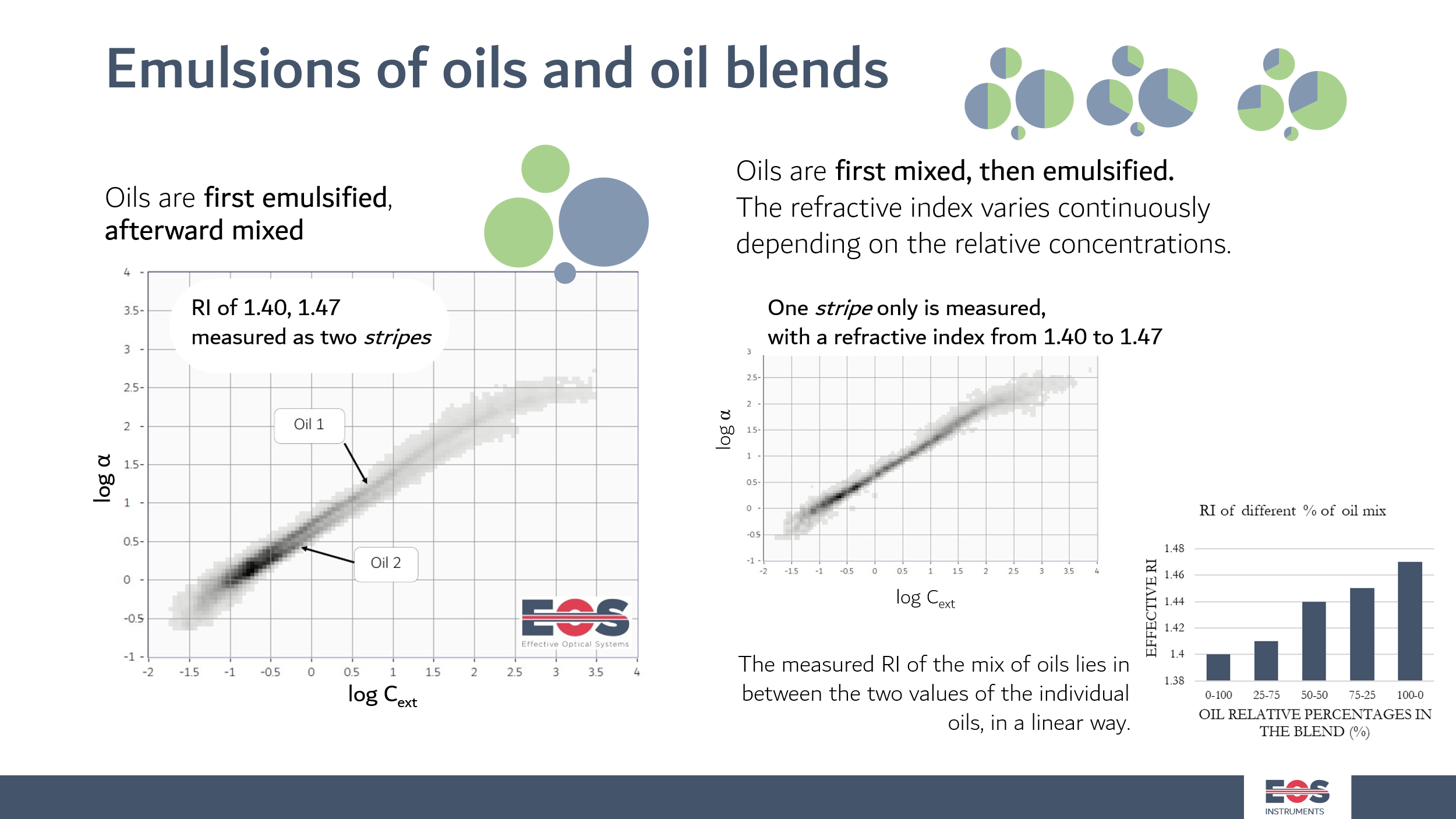
In figure, a study of compelx emulsions with the Classizer One. In the first plot, two oils with slightly different RI are first emulsified them mixed. The Classizer measures two different lines for the two emulsions. In the second plot, the oils are first mixed then emulsified. In this case the instrument measured only one emulsion, with a refractive index which is the average by mixing ratio % of the two oil’s refractive indices.
Formulation Screening and Optimization
Early formulation work often involves testing several compositions in parallel. Particle analysis can provide an objective basis for comparing prototypes and selecting formulations for further development. Changes in ingredient ratios, mixing conditions or processing sequences can be evaluated through their effect on the particulate populations present in the final sample.
This is especially useful when visual inspection alone cannot distinguish between samples. A formulation may look uniform while showing a broader distribution, a new population or a different particle concentration. Detecting these differences early can reduce the amount of time spent developing formulations that later show instability.
Stability and Ageing Studies
Cosmetic products are expected to remain physically consistent throughout their intended storage period. Temperature, repeated thermal cycles, transport, light exposure and time can modify dispersed systems. Monitoring particle populations at different time points helps determine whether the formulation remains stable or develops measurable changes.
A useful stability study should therefore look beyond a single endpoint. Following size distribution, concentration and population structure over time can reveal progressive changes and help compare the behaviour of alternative formulations under the same conditions.
Process Development and Scale-Up
A formulation that performs well at laboratory scale may behave differently when production volumes increase. Mixing energy, pumping, homogenization and filling can alter dispersed populations. Comparing samples before and after relevant process steps can help identify where these changes occur.
Particle characterization can therefore support scale-up by providing quantitative information about whether the particulate profile of the formulation remains consistent as the manufacturing process changes.
Batch-to-Batch Comparison and Quality Control
Once a formulation and process have been established, particle analysis can support routine comparison between batches. Reference data can be used to evaluate whether new production samples show the expected particle populations and whether relevant deviations are present.
The value of this approach is the ability to compare more than one parameter. Two batches with similar average particle size may still differ in concentration or in the presence of a secondary population. Multiparametric data can make these differences easier to recognize and investigate.
Conventional Techniques and the Need for Complementary Information
Cosmetic laboratories use several techniques to study dispersed systems. Dynamic Light Scattering is commonly used for particle-size measurements in suitable small-particle dispersions. Laser diffraction can cover broad size ranges, while microscopy provides direct visual and morphological information. Other optical and separation techniques can be selected according to the formulation and analytical question.
Each method has strengths and limitations. Bulk techniques can provide efficient size measurements but may have difficulty resolving populations that overlap or differ mainly in properties other than size. Microscopy can provide detailed images but may require more time and may analyse a limited number of particles.
For complex cosmetic formulations, complementary multiparametric single-particle analysis can therefore be useful when the objective is to understand how several populations coexist and change within the same sample.
Multiparametric Analysis with SPES Technology
SPES technology developed by EOS Instruments is designed to characterize individual particles through their optical response. With Classizer™ ONE, particle populations in liquids can be evaluated through absolute particle size distribution, numerical concentration and optical characteristics within a single analytical approach.
For cosmetic formulations, the advantage is that particles do not have to be interpreted only according to their dimensions. Populations that occupy similar size ranges but show different optical behaviour can be separated in the analytical representation, providing additional information about sample heterogeneity.
EOS CLOUDS provides a visual way to explore these multiparametric populations. This can make comparisons between formulations, batches and stability time points more intuitive and can help highlight changes that deserve closer investigation.
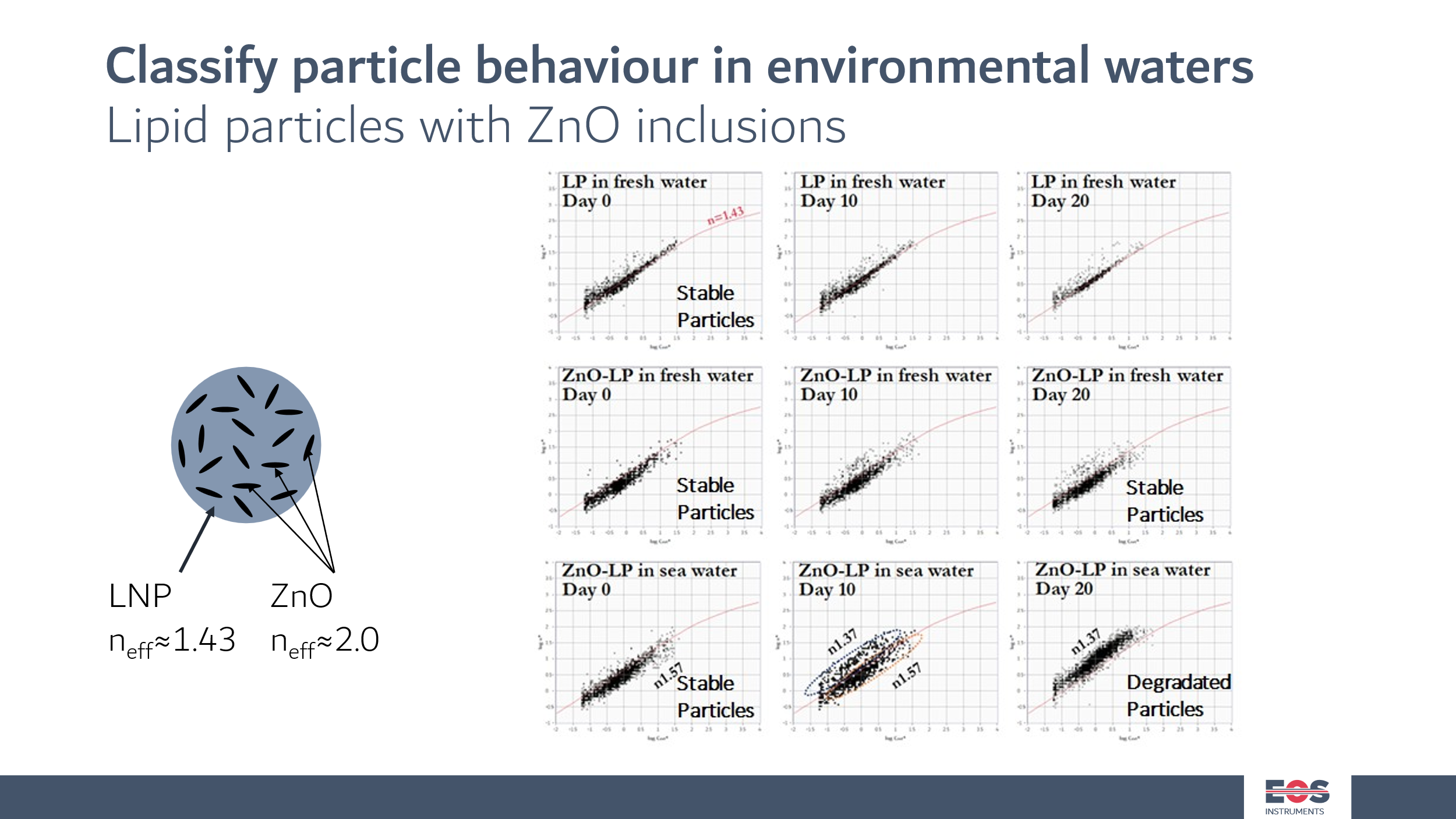
In figure, the stability of a cream with a lipid part and ZnO is studied in normal and sea water. As can be seen from the plots, the one in sea water degrades faster generating a population with a lower RI, which might be made up by the lipid NPs without the ZnO encapsulated inside anymore.
Working with Complex Formulation Matrices
Sample preparation is an important part of particle analysis because dilution, filtration or separation can modify the original particle population. In some cosmetic applications, excessive preparation may remove aggregates or other fractions that are relevant to the question being studied.
Classizer™ ONE is designed for particle analysis in liquids and can support the investigation of heterogeneous samples with limited intermediate preparation where appropriate. This allows researchers to study particle behaviour closer to the conditions of the formulation itself and to reduce the risk of losing information through unnecessary processing.
The analytical workflow should always be selected according to the sample and the objective of the measurement. The key point is to preserve the populations that matter for the formulation question being investigated.
From Development to Automated Analysis
Cosmetic development can involve large numbers of prototypes, repeated stability measurements and routine batch comparisons. In these situations, sample handling becomes part of analytical reproducibility. Standardizing how samples are introduced, measured and cleaned between runs can reduce operator-dependent variability.
EOS sample-management solutions can extend Classizer™ ONE workflows for automated sample handling, sequential measurements and time-resolved studies. Automation can be particularly useful for formulation screening, repeated stability measurements and laboratories that need to process sample series under consistent conditions.
Building a Useful Particle Characterization Strategy
The best analytical strategy starts with a clear formulation question. If the objective is simply to confirm the size of a relatively uniform dispersion, a conventional size technique may be sufficient. If the sample contains several populations or if unexpected changes need to be investigated, additional parameters become more useful.
Particle size distribution, numerical concentration and optical characteristics can then be considered together. Measurements should also be interpreted alongside formulation composition, sample preparation, processing history and storage conditions.
No single technique can describe every aspect of a cosmetic formulation. Microscopy, chemical analysis, rheology and other methods may provide complementary information depending on the product. Multiparametric particle analysis contributes by showing how particulate populations are organized and how they evolve, helping formulators decide where deeper investigation is needed.
Conclusion
Cosmetic and personal care formulations often contain complex combinations of droplets, pigments, dispersed ingredients and other particulate populations. Their behaviour can change during development, manufacturing and storage, making particle characterization an important part of formulation understanding.
A complete analysis should not rely only on average particle size. Size distribution, numerical concentration, optical properties and population heterogeneity provide complementary information that can help distinguish formulations, monitor stability and investigate batch differences.
SPES-based multiparametric analysis with Classizer™ ONE provides a particle-by-particle view of heterogeneous liquid samples. Used alongside established analytical techniques, it can support formulation development, process optimization, stability studies and quality control with a clearer picture of what is happening inside the product.
Related posts
