The SPES technology by EOS Instruments enables accurate particle classification based on optical properties, with a specific focus on the effective refractive index. Once the refractive index is derived through EOS CLOUDS, the software automatically calculates precise particle size distribution and oversize analysis.
Unlike traditional approaches, these results are based on real measured refractive index values, avoiding unreliable or non-reproducible outcomes caused by incorrect assumptions. Thanks to its multiparametric measurement approach, SPES technology directly measures refractive index, delivering accurate and representative particle size distributions without the need for calibration or theoretical models.
This represents a key advantage over traditional particle sizing methods such as Dynamic Light Scattering (DLS), Static Light Scattering (SLS), and Multi-Angle Light Scattering (MALS), which rely on complex inversion algorithms and strong a priori assumptions that can reduce accuracy and reproducibility.
SPES technology by EOS Instruments ensures high resolution and measurement accuracy even in complex heterogeneous samples, including biological fluids where solid content typically limits or prevents reliable characterization using conventional techniques.
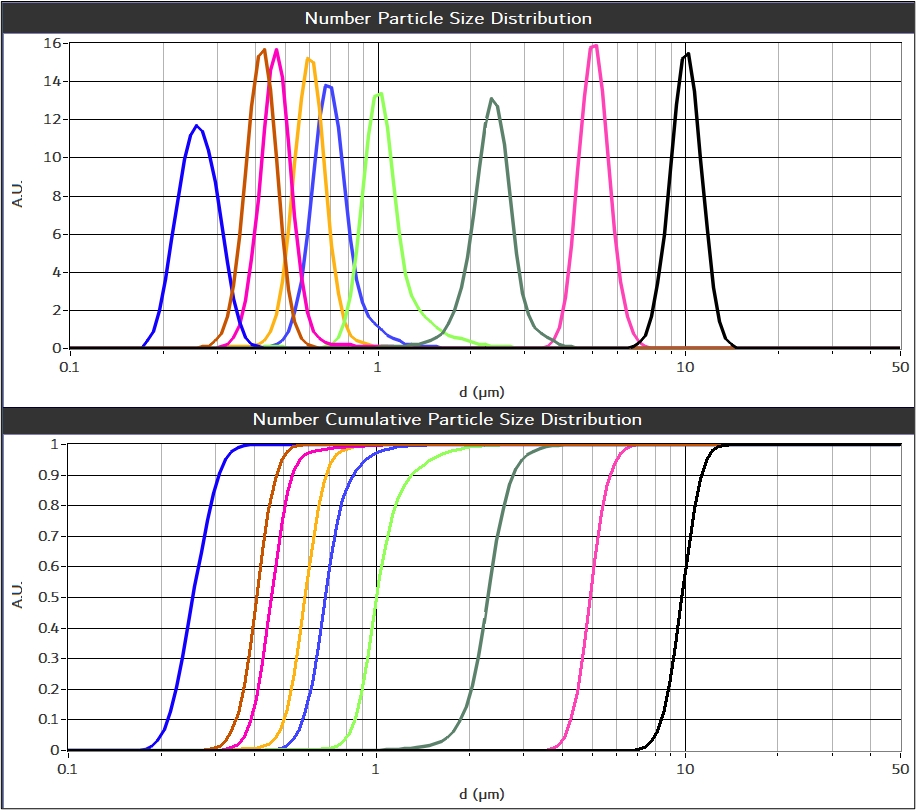
Experimental particle size distribution and cumulative distribution analysis of polystyrene standard samples demonstrate the high resolution and accuracy of SPES technology by EOS Instruments in resolving multiple particle populations across a wide size range.
Reproducibility is a critical requirement for any particle analysis technique, especially in batch-to-batch quality control applications.
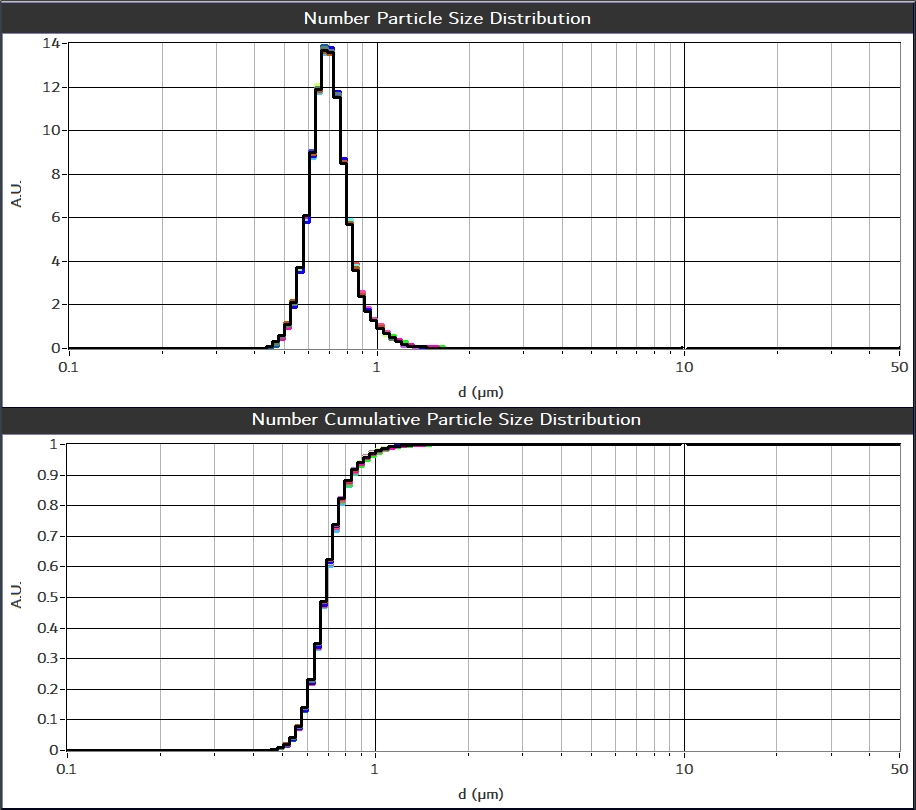
SPES technology by EOS Instruments provides highly reproducible measurements of analytical replicates, supporting accurate validation of particle size distribution and concentration within defined sample preparation conditions.
SPES reproducibility test: multiple analytical replicates of calibrated particle samples confirm the robustness and consistency of SPES technology. The resulting particle size distributions and cumulative curves demonstrate reliable performance, supporting advanced quality control and validation workflows.