

SPES patented technologies by EOS Instruments classifies single particles in complex mixtures by measuring their real optical properties, enabling multiparametric and calibration-free single particle analysis of different particle populations. Each population generates a distinct optical fingerprint in the 2D/3D EOS CLOUDS plots, allowing accurate particle size distribution analysis, effective refractive index evaluation, shape identification and particle compactness assessment.
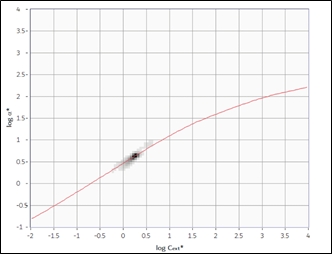
2D EOS CLOUDS histogram of a sample of 0.5 µm polystyrene spheres in MilliQ-grade water, enabling detailed particle characterization. The red line represents a theoretical fit for spherical particles of different sizes, providing an effective refractive index of 1.60, consistent with expected values for polystyrene at 640 nm.
Experimental data generated by SPES technology from EOS Instruments is free from theoretical assumptions about particle shape and refractive index, improving reliability in particle analysis. Data analysis can be performed using different theoretical models, including spherical Mie theory as the default approach, as well as tailored Mie or DDA models. The Classizer™ ONE by EOS Instruments automatically fits the data to the selected model, providing effective refractive index, particle size distribution, numerical concentration and oversize analysis.
Heterogeneous particle samples containing multiple populations, differing in size, shape and refractive index, are challenging to analyse with traditional particle analysis techniques. The Classizer™ ONE by EOS Instruments, leveraging multiparametric SPES measurements, enables accurate identification and characterization of individual particle populations in complex heterogeneous samples, which can be independently selected, analysed and compared. Advanced data analysis and data reduction methods provided by EOS Instruments enable complete and detailed particle characterization.
In the following figures, examples of SPES experimental data from heterogeneous samples containing multiple particle components are presented:
-
a mixture of polystyrene (PS) and PMMA particles of the same size for particle classification analysis
-
a silicon oil emulsion combined with polystyrene particles for heterogeneous particle analysis
-
measurements from a cell lysate containing polystyrene (PS) particles for biological particle analysis
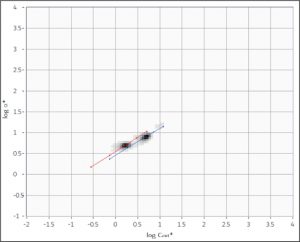
EOS CLOUDS visualization of a mixture of PMMA and PS particles, both 600 nm in diameter, enabling clear particle classification and separation of distinct particle populations. Two well-separated clouds are detected and can be individually selected and analysed, providing accurate refractive index determination and numerical particle concentration. The red and blue lines represent the expected trends for PMMA (RI 1.49) and PS (RI 1.59), respectively.
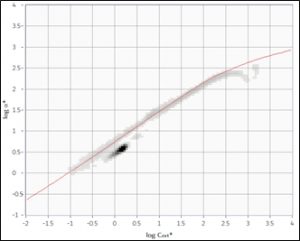
EOS CLOUDS visualization of a silicon oil emulsion containing 0.5 µm polystyrene spheres as traceable particles, enabling advanced heterogeneous particle analysis. Two distinct and well-separated particle populations are clearly identified and classified. The red line represents the expected trend for silicon oil droplets based on their refractive index.
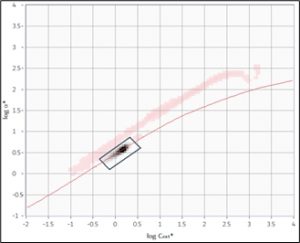
The data in Figure 2 can be filtered with a few clicks to isolate the particle population of interest, in this case polystyrene spheres, enabling extraction of refractive index, particle size distribution (PSD) and oversize analysis. This capability supports targeted particle analysis of single components, detection of tails in polydisperse distributions and identification of impurities.
SPES technology by EOS Instruments discriminates, measures and counts particles with specific optical properties in complex biological samples such as cell lysates containing submicron polymeric particles. SPES enables accurate determination of particle numerical concentration in the supernatant of multiple cell cultures, as well as direct measurement of particle concentration and stability in diluted cell lysates, without the need for purification or filtration.
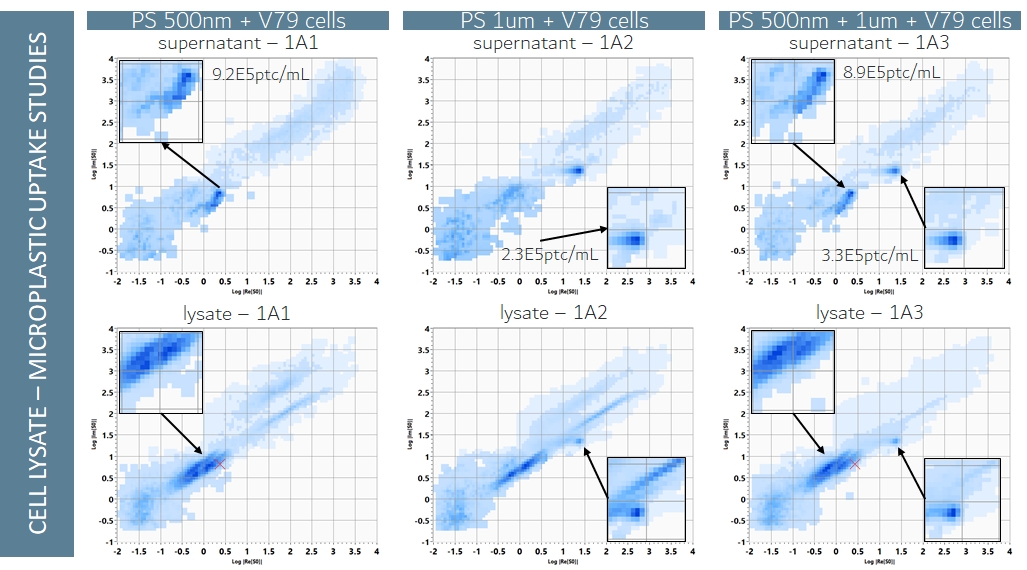
Optical particle classification opens new opportunities in single particle analysis, enabling direct measurement in complex heterogeneous fluids without preliminary purification processes. This approach allows analysis of primary particles while ignoring impurities or secondary populations, improving accuracy and efficiency. This capability is crucial for advanced particle characterization in complex fluids, including drug delivery systems, biological samples and environmental fluids, without the need for filtration or sample preparation.
