Traditional particle sizing techniques such as Laser Diffraction (LD) and Dynamic Light Scattering (DLS) often lack the sensitivity required to accurately measure low particle concentrations in highly diluted samples. This limitation becomes critical when the population of interest represents only a small fraction of the total sample and is masked by more concentrated particle populations.
The SPES technology by EOS Instruments enables precise measurement of particle number concentration, even for secondary or highly diluted particle populations. By analyzing single particles individually, SPES technology can distinguish and exclude signals from unwanted populations or background media, ensuring accurate absolute and relative particle concentration for the target population.
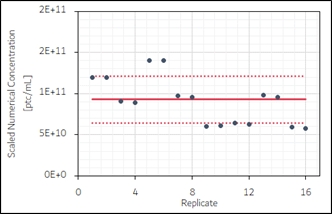
The figure illustrates the measured particle number concentration obtained from multiple analytical replicates of calibrated samples, highlighting the reproducibility and reliability of SPES technology by EOS Instruments. The consistency of results demonstrates the capability to deliver accurate concentration measurements even after dilution corrections.
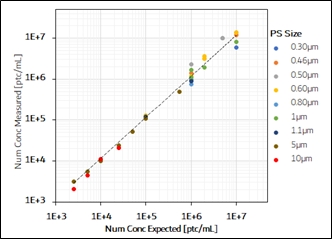
An additional method to evaluate the accuracy of particle concentration measurement is the analysis of calibrated samples across multiple dilution levels, enabling validation of linearity and measurement consistency.
The figure shows the correlation between measured and expected particle concentrations across different sample sizes and dilution levels. The strong linear relationship confirms the high accuracy and quantitative reliability of SPES technology by EOS Instruments in particle number concentration analysis.