

Particle Concentration Measurement
Multiparametric characterization of particles and dispersed populations for formulation development, stability studies and quality control
Agrochemical formulations are designed to deliver active ingredients in a controlled, practical and reproducible way. Many of these products are complex dispersions containing solid particles, droplets, encapsulated materials, carriers, additives and other components within the same liquid matrix. Their physical organization can influence storage stability, handling, dilution and consistency during use.
Particle analysis is therefore an important part of agrochemical formulation development. Particle size distribution is a central parameter, but it does not always describe the complete sample. Two formulations can show similar average sizes while containing different particle concentrations or distinct populations with different optical properties.
Multiparametric single-particle analysis provides a way to investigate this complexity without reducing the formulation to a single average value. By combining size-related information with numerical concentration and optical characteristics, researchers can obtain a more detailed picture of the populations present and how they change during development, processing and storage.
Why Particle Characterization Matters in Agrochemicals
The performance and physical stability of an agrochemical product depend on several interacting factors. Particle size can influence sedimentation and redispersion, while aggregation can modify the original distribution and create larger populations. Changes in the formulation matrix can also affect the way particles remain dispersed over time.
During development, formulators often compare different surfactants, dispersants, concentrations and processing conditions. A formulation may initially appear uniform but evolve differently during storage or after exposure to temperature changes and mechanical stress. Particle characterization makes these differences measurable and helps connect formulation choices with changes in the dispersed phase.
The same information can support process development and quality control. Comparing particle populations between laboratory samples, scale-up trials and production batches can help determine whether the formulation remains consistent throughout manufacturing.
The Challenge of Heterogeneous Agrochemical Samples
Real agrochemical formulations are rarely ideal monodisperse suspensions. They may contain several particle populations with different compositions, structures and functions. Active ingredient particles can coexist with formulation components, carriers, encapsulated materials or unexpected particulate matter.
This creates a practical analytical challenge. Populations may overlap in size even when their origin and behaviour are different. A measurement based only on an average diameter can therefore hide changes that are relevant to formulation stability or batch consistency.
Single-particle information is useful in these situations because it preserves the variability within the sample. Instead of describing the formulation as one population, it becomes possible to investigate whether several groups are present and whether their relative abundance or properties change.
Key Parameters for Agrochemical Particle Analysis
Particle Size Distribution
Particle size distribution describes the range of dimensions present in a formulation and can reveal broadening, shifts or the appearance of larger fractions. These changes may be associated with aggregation, changes in processing conditions or differences between formulations. Looking at the complete distribution is generally more informative than relying only on a mean value.
Numerical Particle Concentration
Numerical concentration indicates how many particles are present within the measured sample. This provides information that size alone cannot supply. A formulation may retain a similar size distribution while the number of particles in a particular population changes, making concentration useful for stability studies and batch comparison.
Optical Properties
Particles with similar dimensions can interact with light differently because of differences in composition, internal structure or compactness. Optical information adds another parameter for separating populations that would otherwise overlap in a conventional size distribution.
Population Structure and Heterogeneity
For complex formulations, understanding how particle populations are organized can be more useful than reducing the sample to one number. Tracking distinct groups over time can help identify changes associated with formulation ageing, processing or stress conditions.
Applications Across Agrochemical Formulation Development
Suspension-Based Formulations
Suspension formulations rely on the controlled dispersion of solid particles in a liquid phase. Their physical behaviour can change if particles aggregate, settle or become difficult to redisperse. Particle characterization can support the comparison of formulation strategies by showing how the dispersed population changes under different conditions.
Measurements performed during development and storage can reveal shifts in size distribution, changes in concentration or the formation of secondary populations. These observations can be combined with other formulation data to build a more complete understanding of suspension behaviour.
Encapsulated and Controlled-Delivery Systems
Encapsulation and other particulate delivery approaches introduce defined carrier populations into an agrochemical formulation. Characterization can help verify the expected particle population and monitor whether it remains consistent during processing and storage.
When carriers coexist with other dispersed components, multiparametric analysis can be particularly useful because the populations may not be distinguishable by size alone. Optical characteristics can provide additional contrast and support population-level comparison.
Emulsion and Multiphase Formulations
Some agrochemical products contain dispersed droplets or multiple phases together with particulate components. These systems can evolve through aggregation, coalescence or other physical changes. Monitoring the distribution of dispersed populations can help compare formulations and investigate stability.
In a multiphase sample, the analytical objective is often to understand whether the same populations remain present under different storage or processing conditions. A multiparametric approach can help highlight changes that would be difficult to interpret from a single bulk measurement.
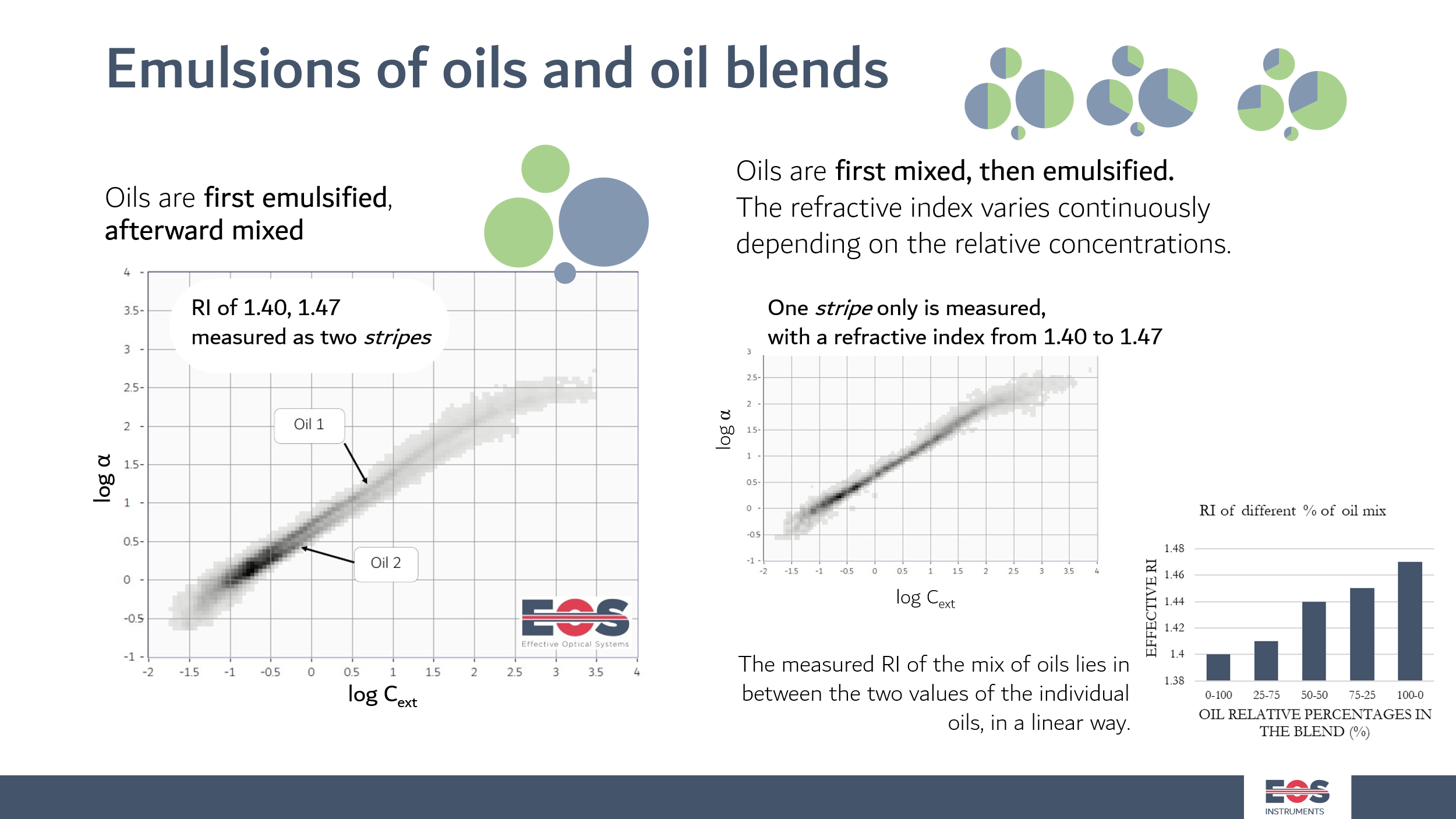
In figure, a study of compelx emulsions with the Classizer One. In the first plot, two oils with slightly different RI are first emulsified them mixed. The Classizer measures two different lines for the two emulsions. In the second plot, the oils are first mixed then emulsified. In this case the instrument measured only one emulsion, with a refractive index which is the average by mixing ratio % of the two oil’s refractive indices.
Formulation Screening
Early-stage development may involve many candidate formulations. Changes in dispersant, surfactant, concentration, pH or processing conditions can alter the particle populations even when the products look similar by visual inspection.
Particle analysis provides quantitative information for comparing these prototypes. Formulators can identify samples that maintain a more consistent population profile and focus further testing on the most promising candidates.
Stability and Ageing Studies
Storage time and environmental conditions can progressively change dispersed agrochemical systems. Temperature cycles, agitation and prolonged storage may affect aggregation, sedimentation and population structure.
Measurements performed at defined time points allow these changes to be followed rather than evaluated only at the end of a study. This makes it possible to compare the stability paths of different formulations and to recognize when a new particle population begins to develop.
Sedimentation and Redispersion
Sedimentation is an important consideration for many particulate formulations. A formulation can contain the correct ingredients and still become difficult to use if particles settle rapidly or form structures that are not easily redispersed.
Particle measurements taken at different times or sampling positions can contribute to the study of these processes by showing how concentration and population structure evolve. When combined with controlled sampling workflows, this approach can support a more detailed assessment of settling behaviour.
Process Development and Scale-Up
Moving from laboratory preparation to production scale changes mixing, pumping and fluid-handling conditions. These changes can affect particle populations and may lead to differences between a development sample and the manufactured formulation.
Comparing samples at relevant process stages can help identify where changes occur. Particle size, concentration and population patterns can then be used as part of the evidence for optimizing process conditions and maintaining formulation consistency during scale-up.
Batch-to-Batch Comparison and Quality Control
Once a product and manufacturing process have been established, particle characterization can support routine comparison between batches. A reference population profile can provide more information than a single size specification, particularly for heterogeneous formulations.
Changes in concentration, distribution width or the presence of an additional population can be detected and investigated. Statistical comparison can further support the identification of samples that deviate from the expected formulation profile.
Conventional Particle Analysis Techniques
Agrochemical laboratories use several established techniques to characterize dispersed systems. Laser diffraction is widely used for particle size distribution across broad dimensional ranges. Dynamic Light Scattering can be useful for suitable smaller-particle dispersions, while microscopy provides direct visual information about particle morphology and aggregation.
Other techniques may be selected according to the formulation, concentration and analytical objective. Each method answers a specific question, and no single technique provides every type of information.
The main limitation of bulk measurements appears when several populations overlap or when a minor population is masked by the dominant fraction. In these cases, complementary single-particle and multiparametric information can provide a clearer description of formulation heterogeneity.
Multiparametric Analysis with SPES Technology
SPES technology developed by EOS Instruments characterizes individual particles through their optical response. With Classizer™ ONE, particle populations in liquids can be analysed in terms of absolute particle size distribution, numerical concentration and optical characteristics within the same analytical workflow.
For agrochemical formulations, this provides a way to investigate heterogeneous samples without interpreting every particle only through its size. Populations with similar dimensions but different optical behaviour can appear as distinct groups, adding information about the structure of the formulation.
EOS CLOUDS provides a visual representation of these multiparametric populations. This can simplify comparisons between formulations, storage time points or production batches and help researchers identify changes that require further investigation.
Analysis Closer to the Original Formulation
Sample preparation can influence particle measurements. Dilution, filtration and separation may alter aggregation states or remove populations that are relevant to the formulation question. For complex samples, reducing preparation steps can therefore help preserve useful information.
Classizer™ ONE is designed for particle analysis in liquids and can support measurements of heterogeneous samples with limited intermediate preparation where appropriate. This allows particle behaviour to be investigated closer to the conditions of the original formulation.
The appropriate workflow still depends on sample composition, concentration and the objective of the analysis. The important point is to avoid unnecessary preparation that changes the population being studied.
Automated and Time-Resolved Workflows
Agrochemical development frequently involves repeated measurements: multiple formulation candidates, storage time points, sedimentation studies or production batches. Standardized sample handling can improve consistency and reduce operator-dependent variation.
EOS sample-management solutions can extend Classizer™ ONE workflows through automated sample handling, sequential analysis and time-resolved measurements. These capabilities can support formulation screening and studies in which samples need to be analysed repeatedly under controlled conditions.
A Practical Characterization Strategy
A useful particle analysis strategy begins with the question that needs to be answered. A simple and relatively uniform suspension may require only a conventional size distribution. A heterogeneous formulation, or a sample in which an unexpected change has occurred, may require additional information.
Combining particle size distribution, numerical concentration and optical properties can help determine whether the sample contains one dominant population or several distinct groups. Results should then be interpreted together with formulation composition, processing history, storage conditions and sample preparation.
Particle analysis is most effective when used as part of a complementary analytical workflow. Microscopy, chemical analysis, rheological measurements and other techniques may be needed to answer questions about morphology, chemical identity or bulk formulation behaviour. Multiparametric analysis contributes by showing how individual particle populations differ and evolve.
Conclusion
Agrochemical formulations can contain complex and dynamic particle populations. Their size, concentration and organization may change during formulation development, manufacturing and storage, affecting the physical consistency of the product.
A particle characterization strategy based only on average size can miss relevant differences between samples. Multiparametric single-particle analysis adds numerical concentration and optical information, helping researchers distinguish populations and follow their evolution.
SPES-based analysis with Classizer™ ONE can complement established particle characterization techniques in formulation screening, stability studies, sedimentation analysis, process development and batch comparison. The result is a more detailed view of heterogeneous agrochemical formulations and a stronger basis for development and quality-control decisions.
Related posts
