

Particle Concentration Measurement
Advanced characterization of heterogeneous particles for formulation development, stability studies and pharmaceutical quality control
Particles are present in many pharmaceutical products by design, by process, or as a consequence of physical and chemical changes during storage. In suspensions and drug-delivery systems they may be an essential part of the formulation. In other products, unexpected particles can indicate aggregation, precipitation, contamination or instability. Understanding these populations is therefore important throughout pharmaceutical development, from early formulation screening to process optimization and quality control.
Particle analysis in pharmaceutical formulations is not simply a matter of reporting an average diameter. Real samples can contain several populations at the same time: active pharmaceutical ingredient particles, excipients, droplets, carriers, aggregates and unwanted particulate matter. These populations may overlap in size while differing in composition or optical behaviour. A useful analytical method must therefore provide enough information to separate meaningful changes in the formulation from normal sample variability.
Multiparametric single-particle analysis addresses this challenge by looking at individual particles and combining size-related information with concentration and optical properties. For pharmaceutical scientists, this can provide a clearer view of formulation heterogeneity and help answer practical questions about stability, batch consistency and process-induced changes.
Why Particle Characterization Matters in Pharmaceutical Development
The physical state of a particulate formulation can influence how a product is manufactured, stored and ultimately performs. Particle size distribution affects sedimentation, dissolution, surface area and suspension behaviour. Particle concentration can reveal changes that are not obvious from size alone, while the appearance of a new population may indicate aggregation, precipitation or contamination.
These effects are especially relevant during formulation development. Changes in pH, ionic strength, excipient composition, temperature or mixing conditions can alter particle interactions. A formulation that appears stable immediately after preparation may evolve during storage, transport or repeated handling. Monitoring particle populations over time helps researchers identify these changes before they become visible at the macroscopic level.
Particle characterization also supports process development. Filtration, pumping, mixing, filling and other manufacturing steps can modify a dispersion or introduce unwanted particulate matter. Comparing samples before and after a process step can help determine whether the formulation remains within the expected physical profile.
The Challenge of Heterogeneous Pharmaceutical Samples
Pharmaceutical samples are often more complex than ideal reference suspensions. A single formulation may contain particles with different chemical compositions, refractive indices and structures. Some populations may be intentionally present, while others may develop only under specific stress conditions.
This heterogeneity creates an analytical problem: two particles with similar dimensions are not necessarily equivalent. A protein aggregate, an excipient particle and a lipid-based carrier may fall within a comparable size range but have very different origins and implications for product quality. If an analytical technique reduces the entire sample to one average value, these differences can be difficult to recognize.
For this reason, pharmaceutical particle analysis increasingly benefits from methods that preserve information at the individual-particle level. The goal is not to replace every established technique, but to add another dimension to the characterization workflow when size alone does not explain what is happening in the sample.
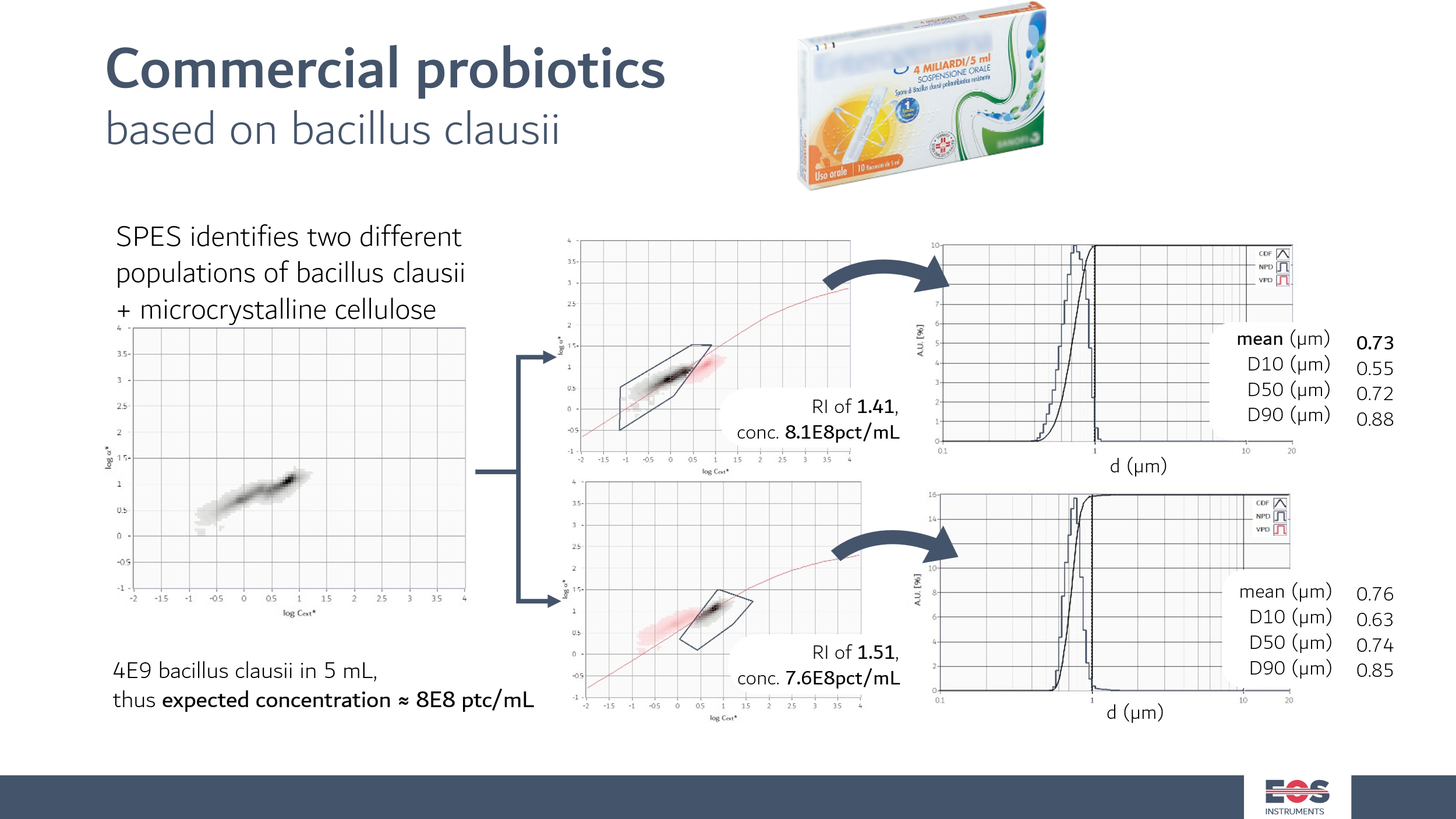
In figure, an example of measurements of a commercial probiotics product. The Classizer One identifies clearly two different populations that, interestingly, have similar sizes but different optical properties.
One population, selected in the upper panel, has a RI of 1.41: that’s the bacteria. The second one, in the lower plots, has a higher refractive index of 1.51. That could be the micronized cellulose present in the ingredients. Their absolute concentration is the same, as well as their sizes. This example showcases the capabilities of the Classizer One in measuring complex pharmaceutical products and in their (reverse) engineering.
What Should Be Measured?
Particle Size Distribution
Particle size distribution remains one of the first parameters considered when evaluating a pharmaceutical dispersion. It provides information about the width of the population and can reveal the presence of smaller or larger fractions that would be hidden by a single mean value. Changes in the distribution can indicate aggregation, fragmentation, precipitation or differences between production batches.
Numerical Concentration
Knowing how many particles are present adds important context to size data. Two samples can show similar size distributions while containing very different numbers of particles. Numerical concentration is therefore useful when monitoring formulation changes, comparing batches or evaluating whether a stress condition has generated a new particulate population.
Optical Properties and Effective Refractive Index
Optical information can help distinguish populations that overlap in size. Effective refractive index is related to how a particle interacts with light and can provide additional information about differences in composition, compactness or internal structure. In heterogeneous formulations, this can make it easier to recognize populations that would otherwise appear as a single size class.
Population Heterogeneity
For many pharmaceutical applications, the most useful result is not one number but a map of the populations present in the sample. Identifying clusters and following their evolution can provide a direct way to compare formulations, investigate unexpected changes and monitor stability over time.
Applications Across the Pharmaceutical Workflow
Formulation Development
During formulation development, particle analysis can be used to compare candidate compositions and understand how formulation variables affect the dispersed phase. Researchers can evaluate whether changes in excipients, buffers or processing conditions alter particle size, concentration or population structure. This is particularly useful when several formulations appear similar by visual inspection but behave differently during storage.
Stability and Stress Studies
Temperature changes, freeze-thaw cycles, agitation, light exposure and prolonged storage can all modify particulate systems. Time-resolved analysis makes it possible to follow these changes and determine whether new particle populations appear, existing populations grow, or concentration shifts over the course of a study.
Rather than waiting for visible sedimentation or turbidity, researchers can use particle-level information to investigate early changes in the formulation and compare the effect of different storage or stress conditions.
Process Development and Scale-Up
Moving from laboratory preparation to larger-scale manufacturing can introduce new mechanical and fluidic stresses. Particle measurements taken at different stages of the process can help identify where changes occur and whether mixing, pumping, filtration or filling affects the formulation. This provides useful evidence when optimizing process parameters and assessing manufacturing robustness.
Batch-to-Batch Comparison and Quality Control
Routine comparison of particle populations can support batch consistency and out-of-specification investigations. A reference batch can be compared with subsequent production samples not only in terms of size distribution but also through concentration and optical population patterns. Statistical approaches can further highlight deviations that may deserve investigation.
Unwanted Particles and Formulation Changes
Unexpected particulate matter can arise from several sources, including raw materials, packaging interactions, process equipment or instability of the formulation itself. Characterizing these particles does not automatically identify their chemical origin, but separating an abnormal population from the expected formulation can provide a useful first step for troubleshooting and for selecting complementary analytical techniques.
Conventional Particle Analysis Techniques
Pharmaceutical laboratories use a range of established methods for particle characterization. Dynamic Light Scattering is widely used for rapid size measurements in nanoscale dispersions. Laser diffraction covers broad size ranges and is common in many industrial applications. Nanoparticle Tracking Analysis can provide particle-by-particle size and concentration information for suitable samples, while light obscuration and flow imaging are established tools for larger and subvisible particles.
Microscopy and electron microscopy provide valuable morphological information, and separation techniques can help investigate specific components of complex samples. Each method answers a different analytical question. The choice depends on particle size, concentration, sample composition and the type of information required.
The limitation appears when a heterogeneous formulation contains populations that overlap in size or when average measurements hide a minor but relevant fraction. In these cases, complementary multiparametric analysis can help describe the sample more completely.
Multiparametric Pharmaceutical Particle Analysis with SPES
SPES technology used by EOS Instruments is designed to characterize individual particles through their optical response. With Classizer™ ONE, particle populations in liquids can be analysed in terms of absolute particle size distribution, numerical concentration and optical characteristics within the same measurement workflow.
This is particularly useful for heterogeneous pharmaceutical samples because populations do not have to be interpreted only through size. Particles with similar dimensions but different optical behaviour can appear as separate groups, helping researchers investigate formulation complexity and follow changes between samples.
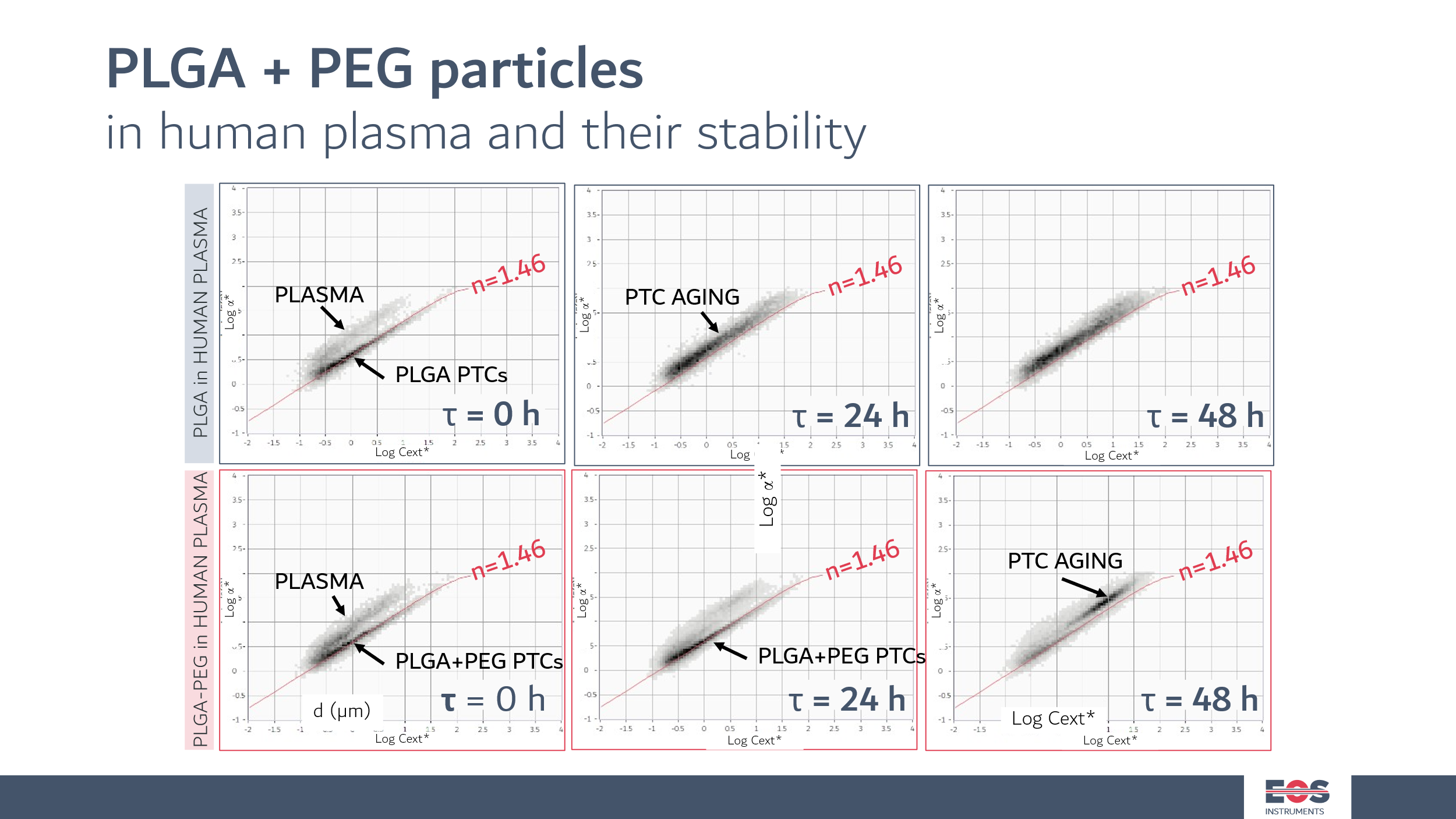
In figure, PLGA nanoparticles with high RI of 1.46 are measured alongside a blood sample (upper cloud). In the first row, SPES data of PLGA made without the use of a surfactant as a stabilizier. In the course of 48 h, the particles degrades and age. In the bottom row, PLGA particles stabilized with a surfactant. As it can be seen, they survive almost unalterated at the 24h timestamp. At 48 h, a population with bigger sizes and lower RI can be observed that can be interpreted as swelling of the particles.
EOS CLOUDS provides a visual representation of these populations. Instead of looking only at a conventional one-dimensional size distribution, the user can examine how different particle groups are distributed across multiple parameters. This can simplify comparisons between formulations, batches or time points and make unusual populations easier to recognize.
Direct Analysis of Complex and Non-Filtered Samples
Sample preparation can influence the result of a particle measurement. Filtration, purification or separation may remove the very populations that a researcher wants to investigate. For suitable samples, the ability to analyse heterogeneous liquids with limited preparation can therefore be valuable.
Classizer™ ONE is designed for particle analysis in liquids and can support measurements in complex matrices without requiring every sample to be reduced to an ideal purified suspension. This allows particle behaviour to be studied closer to the formulation conditions in which it actually occurs, while reducing intermediate handling steps.
From Single Measurements to Automated Workflows
Pharmaceutical development often requires more than an isolated measurement. Stability studies, formulation screening and quality-control programmes may involve many samples or repeated measurements over time. Automation can improve consistency by reducing manual handling and standardizing sampling conditions.
EOS sample-management solutions can extend Classizer™ ONE workflows for automated sample handling, sequential measurements and time-resolved studies. This is useful when comparing multiple formulations, monitoring sedimentation or ageing, or processing repeated measurements under controlled conditions.
Typical Pharmaceutical Samples
Multiparametric particle analysis can support the investigation of a broad range of pharmaceutical and biopharmaceutical samples. Examples include suspensions containing active ingredients or excipients, drug-delivery particles, lipid-based systems, protein-containing formulations, emulsions, microcapsules and other heterogeneous dispersions.
The analytical question remains central. In some cases the objective is to confirm a target particle distribution; in others it is to detect aggregation, compare formulations, monitor ageing or investigate an unexpected population. Defining that question first helps determine which particle parameters and complementary techniques are most useful.
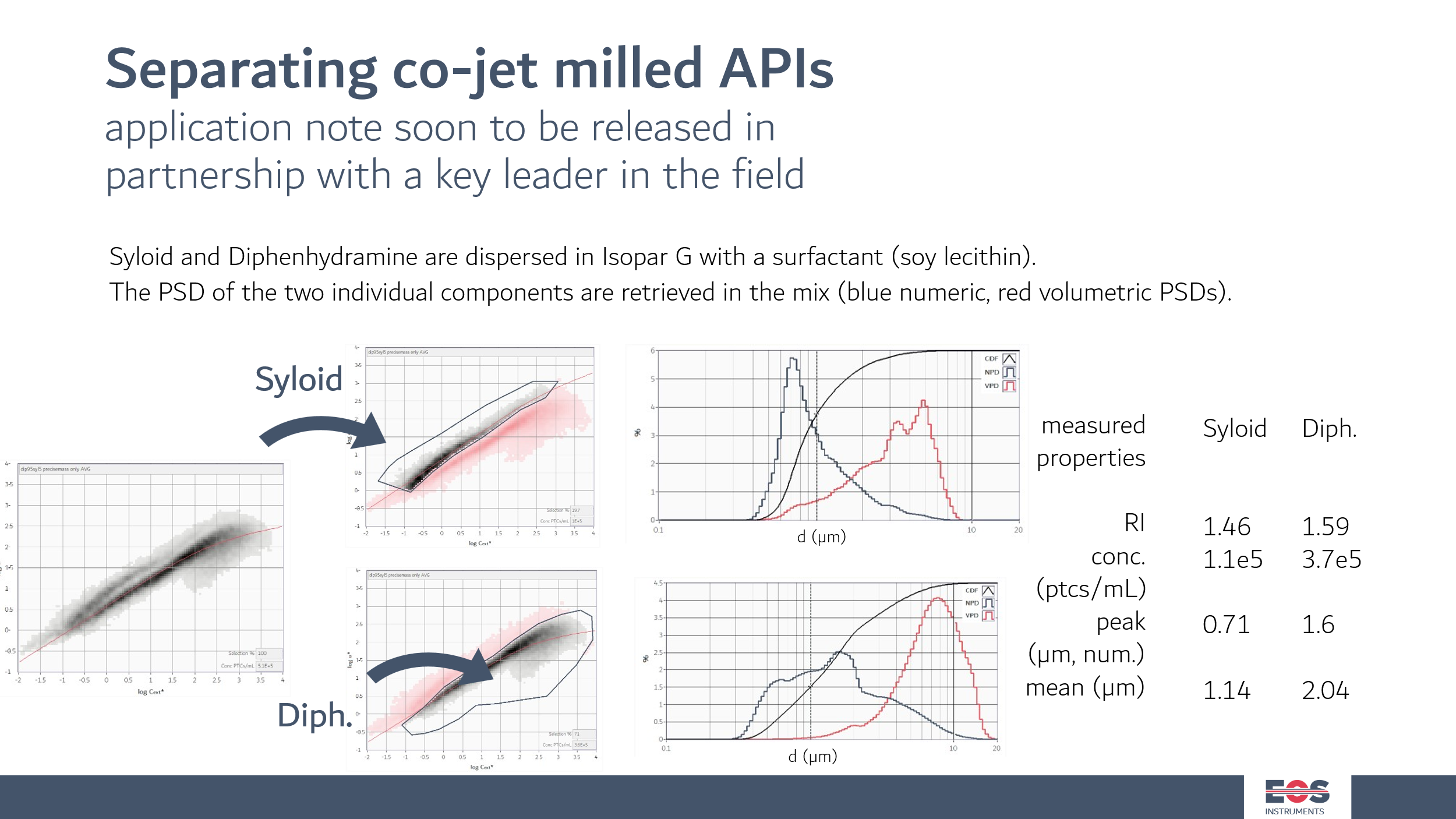 In the figure, a measurement of co-jet milled API powders dispersed in liquid is shown. As it can be seen on the entire SPES data on the left, the sample shows clearly two populations. The upper one is the excipient, silica, RI 1.45; the second one is the API, with a higher RI of 1.59. Both Ris and PSDs can be retrieved independently.
A Practical Approach to Pharmaceutical Particle Characterization
A robust particle-characterization strategy starts by understanding what the formulation is expected to contain and what type of change would be meaningful. Size distribution may be sufficient for a simple, uniform suspension. More complex samples may require concentration, optical information and population-level comparison.
Measurements should also be interpreted in the context of sample preparation, concentration and handling history. Results obtained after dilution or filtration may answer a different question from measurements performed closer to the original formulation conditions. Where possible, analytical workflows should be designed to preserve the features that are relevant to the development or quality-control objective.
No single particle technique provides every answer. Combining complementary methods is often the most effective approach, particularly when morphology, chemical identity or surface properties are also required. Multiparametric single-particle analysis adds value by showing how particle populations differ and evolve, helping researchers decide where further investigation is needed.
Conclusion
Particle analysis is an important part of pharmaceutical formulation development because particulate populations can affect stability, processability and product consistency. The challenge is that real formulations are often heterogeneous, and particles with similar sizes may have different origins or physical properties.
By combining particle size distribution, numerical concentration and optical characterization at the individual-particle level, SPES technology provides a detailed view of complex dispersions. This information can support formulation screening, stability studies, process development, batch comparison and troubleshooting without reducing every sample to a single average value.
For pharmaceutical laboratories, the practical benefit is a clearer understanding of what is present in the formulation and how those populations change. That insight can complement established analytical methods and support more informed decisions throughout development and quality control.
Related posts
