

Particle Concentration Measurement
Detecting and quantifying large-particle tails, aggregates and out-of-spec populations
What is oversize particle analysis?
Oversize particle analysis focuses on particles that exceed a defined dimensional threshold within a sample. These particles may represent aggregates, contaminants, process deviations or simply the large-size tail of an otherwise acceptable particle distribution.
The analytical importance of oversize particles is often disproportionate to their concentration. A small number of large particles can affect filtration, nozzle performance, surface finish, formulation stability, product appearance or downstream processing even when the average particle size remains within specification.
Oversize analysis therefore complements conventional Particle Size Distribution measurements. Instead of describing only the centre of the distribution, it asks a specific Quality Control question: how many particles exceed the critical size, and what are their characteristics?
Why average particle size can hide oversize populations
Mean, median and modal particle sizes summarize a distribution, but they do not always describe its tails. A sample containing a very small fraction of large particles can have almost the same average size as a sample with no oversize fraction.
This is especially relevant in polydisperse systems and complex formulations. A rare aggregate population can be statistically masked by thousands of smaller primary particles. Bulk measurements may indicate only a slight broadening of the distribution, and instruments relying on volumetric measurements or quantities are thus inherently inadequate in providing this class of measurements, like Dynamic Light Scattering (DLS) and Static Light Scattering.
Single-particle analysis evaluates detected events individually and is therefore well suited to investigating low-concentration oversize populations. Critical thresholds can be applied directly to the measured particle population.
Defining an oversize threshold
An oversize threshold is a particle size value selected according to the application, product specification or process requirement. Particles above that value are counted and analysed as the oversize fraction.
There is no universal threshold that applies to every sample. A critical size for an ink formulation may be very different from the threshold used for a pharmaceutical dispersion, polymer suspension or abrasive slurry.
The threshold should therefore be linked to a real analytical or functional requirement. Once defined, it can be applied consistently across batches, stability time points or process conditions.
What can be measured in an oversize analysis?
Oversize number concentration quantifies how many particles per mL exceed the selected threshold.
Oversize fraction describes the contribution of large particles relative to the measured population and can be used for sample comparison.
Particle Size Distribution above the threshold shows how the large-particle tail is structured rather than reporting only a single count.
Optical properties can help determine whether the oversize fraction belongs to the same material as the primary population or represents a different component.
Population-specific oversize analysis can be applied when several particle populations coexist in the same sample and only one component is relevant to the specification.
Oversize particles, aggregates and contaminants
Large particles can have different origins. Aggregation can create clusters from otherwise well-dispersed primary particles. Contamination can introduce foreign particles. Incomplete milling or homogenization can leave a coarse fraction. Storage can generate new oversize populations as a formulation ages.
Distinguishing these possibilities requires more than size alone. If the large particles have optical properties consistent with the primary population but a different structural response, aggregation may be suspected. If they form a separate optical population, they may represent another material or contaminant.
Additional analytical techniques may be required for definitive chemical identification, but multiparametric particle analysis can provide an important first level of classification.
Oversize analysis in formulation stability
Oversize monitoring is a useful indicator during stability studies because the large-particle tail can change before the complete Particle Size Distribution shifts significantly.
A growing oversize fraction may indicate aggregation, flocculation or other structural changes. Repeated measurements can show whether the increase is gradual, sudden or associated with specific storage or stress conditions.
Combining oversize data with numerical concentration, effective refractive index and population structure provides a more complete picture of formulation stability.
Oversize particles in pigments and inks
In pigments and inks, large particles can affect dispersion quality and may contribute to surface defects or operational problems such as printhead nozzle clogging. Monitoring the upper tail of the distribution is therefore relevant even when most particles are within the desired range.
Oversize analysis can compare formulations, milling conditions or batches and determine whether a process change reduces the coarse fraction.
When several pigment or additive populations coexist, optical classification can help evaluate the oversize fraction of a selected component rather than only the total sample.
Oversize analysis in polymeric and engineered particles
Polymeric dispersions and engineered particle systems often require tight control of size distribution and aggregation. A minor oversize fraction can indicate incomplete dispersion, particle fusion or instability.
Single-particle measurements can identify and count large particles while preserving information about the main population. This supports formulation optimization, process development and batch-to-batch comparison.
For engineered particles, optical information can also help distinguish oversized primary particles from aggregates or secondary materials when their properties differ.
Oversize monitoring in powders, minerals and abrasives
Ground powders, mineral dispersions and abrasive slurries can contain broad particle size distributions. The coarse fraction may influence processing, surface interaction and final product consistency.
Monitoring particles above a defined threshold can support milling and homogenization studies by showing whether the process is effectively reducing the large-particle tail.
Because these materials may also contain irregular or compositionally different particles, multiparametric analysis can add structural and optical information to the dimensional result.
How Classizer™ ONE performs oversize analysis
Classizer™ ONE measures individual particles using patented SPES technologies. The Classizer™ Software Platform can apply customizable oversize thresholds to measured populations and compare oversize behaviour across different samples or batches.
Because individual particle populations can be selected within EOS CLOUDS, oversize analysis can be performed on the complete sample or on a specific population when the mixture contains optically distinguishable components.
Results can be combined with Particle Size Distribution, numerical concentration and effective refractive index to support a more detailed interpretation of the large-particle fraction.
Oversize analysis for batch-to-batch Quality Control
Batch comparison is one of the clearest applications of oversize analysis. A reference batch can establish the expected upper tail, while subsequent batches are evaluated using the same threshold and measurement workflow.
A batch may pass an average particle size specification while still containing an unusual number of large particles. Oversize analysis provides a dedicated metric for identifying this difference.
When combined with statistical methods such as Principal Component Analysis, oversize information can contribute to a broader multiparametric Quality Control strategy.
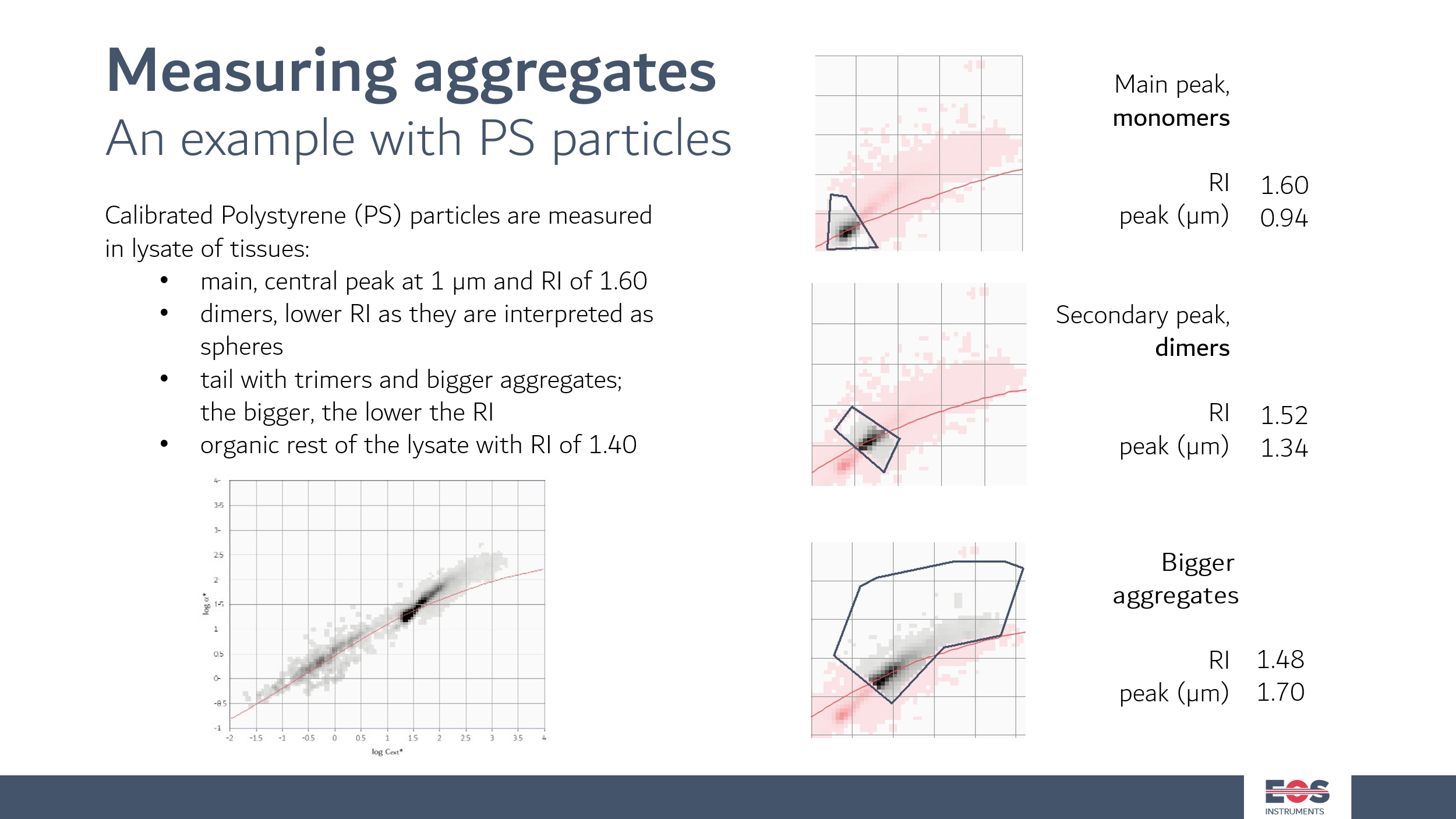
Figure: an example of aggregation and oversize analysis in a sample of polystyrene sphere. Beside the main peak at 1 um, a broad distribution with bigger sizes and lower RI is measured using a Classizer ONE. The varying RI measured thanks to SPES is a clear indication of aggregations, as bigger objects include a larger fraction of water and thus are measured having a lower average refractive index. SPES thus demonstrate the aggregation of the sample and correctly size and retrieves the RI of the different portions of the aggregates
Oversize analysis in heterogeneous samples
In a heterogeneous formulation, the largest particles in the total sample may not belong to the component of interest. A secondary material can dominate the upper tail and make a global oversize value difficult to interpret.
Optical particle classification can separate populations before the threshold is applied. This makes it possible to evaluate oversize content for the target population while retaining information about other components.
This population-specific approach is particularly useful for formulations, environmental samples and industrial fluids containing multiple particle types.
Oversize analysis compared with conventional particle sizing
Laser diffraction and other established sizing techniques provide valuable information about broad Particle Size Distributions and are widely used in industrial characterization. Microscopy can directly visualize large particles and provide morphological detail.
Oversize analysis with a single-particle optical platform answers a more targeted question by counting and characterizing individual particles above a selected threshold. Its value is strongest when the oversize population is rare, when several populations coexist or when optical classification is required.
The most appropriate method depends on particle size range, sample concentration, required sensitivity and the consequences associated with the oversize fraction.
Frequently asked questions about oversize particle analysis
What is an oversize particle? It is a particle larger than a critical threshold defined for a specific product, process or analytical objective.
Why is oversize analysis different from average particle size? Average values describe the centre of a distribution, while oversize analysis focuses specifically on its large-particle tail.
Can rare aggregates be included in oversize analysis? Yes. When aggregates exceed the selected threshold and are detected individually, they can contribute to the oversize population and may also be classified according to their optical properties.
Can oversize thresholds be customized? Yes. The Classizer™ Software Platform supports customizable thresholds for comparison of particle populations and batches.
Can oversize analysis be performed on one population within a mixture? When populations can be optically classified, the selected population can be analysed independently.
A focused metric for critical large particles
Oversize particles can be few in number but important in practice. Their presence may indicate instability, contamination, incomplete processing or a deviation from the expected product profile.
A dedicated oversize analysis makes the upper tail of the distribution measurable and comparable. When combined with single-particle classification, numerical concentration and optical information, it also helps determine which population is responsible for the result.
Classizer™ ONE and SPES technology provide a multiparametric approach to oversize analysis for formulation development, process optimization, stability studies and Quality Control.
Related posts
