

Particle Concentration Measurement
Classifying and characterizing multiple particle populations in complex fluids
What is heterogeneous particle mixture analysis?
Heterogeneous particle mixture analysis is the characterization of samples that contain two or more particle populations with different physical, optical or structural properties. These populations may differ in material, particle size, refractive index, shape, concentration or internal structure, and they can overlap strongly in conventional size measurements.
Complex particle mixtures are common in real formulations and environmental samples. A liquid may contain polymer particles and oil droplets, active particles and carriers, pigments and additives, cells and debris, minerals and microplastics, or primary particles together with aggregates and contaminants.
The central analytical problem is therefore not simply to measure the average size of the sample. It is to determine which populations are present, separate them analytically and characterize each population independently.
Why complex particle mixtures challenge conventional sizing
Many particle sizing methods convert the response of the entire sample into a global size distribution. This can work well for simple systems, but interpretation becomes more difficult when several materials occupy the same dimensional range.
Two populations can have nearly identical particle sizes and still differ substantially in composition or optical properties. In a one-dimensional size histogram, they may appear as a single peak. A minor population can also be hidden by a more abundant component.
This is one reason why heterogeneous particle analysis benefits from multiparametric measurements. Adding independent optical information creates additional dimensions that can separate populations even when size alone cannot.
What information is needed to characterize a particle mixture?
Particle Size Distribution remains fundamental because it describes the dimensional range of the complete sample and of individual populations.
Numerical concentration shows how many particles are present. When populations can be classified separately, concentration can be calculated for each component rather than only for the whole sample.
Effective refractive index provides information related to optical composition and can help distinguish materials with similar dimensions.
Shape, compactness and structural information can add further discrimination in samples containing irregular particles, aggregates, capsules or other complex structures.
Relative population abundance is often as important as the properties of the particles themselves. A formulation may remain dimensionally stable while the proportion of its components changes.
Particle populations with overlapping size distributions
Overlapping size distributions are a common source of ambiguity. For example, two polymer materials can contain particles of the same nominal diameter while having different refractive indices. Oil droplets and solid particles can also occupy the same size range.
If the analytical method reports only size, these populations may be impossible to distinguish. The resulting distribution describes the mixture but not its composition.
Optical classification addresses this limitation by placing individual particles in a multiparametric space. Populations that overlap in size can separate according to their optical fingerprint, allowing independent analysis.
Optical fingerprints and EOS CLOUDS
SPES, Single Particle Extinction and Scattering, measures independent optical properties of each detected particle. Tens of thousands of particle events can then be represented in EOS CLOUDS, a two-dimensional or multidimensional map of the sample.
Particles with similar optical properties form clusters or clouds. In a heterogeneous sample, different materials or structures can generate distinct clouds that can be selected individually.
Once a population has been selected, its Particle Size Distribution, numerical concentration, effective refractive index and other available parameters can be evaluated without requiring the entire sample to be treated as one distribution.
Examples of heterogeneous particle mixtures
A mixture of polystyrene and PMMA particles demonstrates the value of optical classification. The two materials can have the same nominal particle size but different refractive indices, producing distinct optical populations.
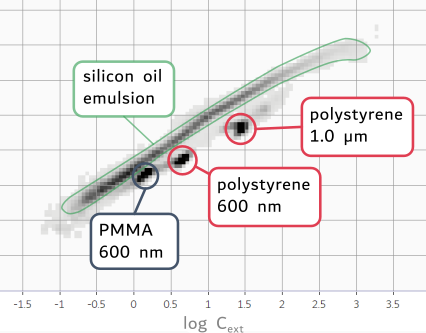
Figure 1: polystyrene and PMMA particles of 600 nm do not overlap on a SPES measurement, due to their different optical properties and refractive index. The same sample contains a silicon oil emulsion that is again fully separated by the two polymeric particles thanks to the optical classification capabilities of SPES.
An oil-in-water emulsion containing polymer particles represents another type of heterogeneous sample. Droplets and solid particles may overlap dimensionally but differ optically, allowing their populations to be separated in a multiparametric representation.
Biological fluids can contain cells, debris, proteins, delivery particles and other structures. Environmental fluids can contain minerals, microplastics, carbonaceous particles and natural particulate matter. In each case, the analytical objective is to isolate the population relevant to the study without losing information about the surrounding sample.
Heterogeneous particle analysis without unnecessary separation steps
Traditional workflows may use filtration, purification, centrifugation or fractionation to isolate a target population before analysis. These steps can be useful or necessary in many methods, but they also add time and can alter the original sample.
When particle populations have sufficiently distinct optical properties, SPES can support direct classification within the heterogeneous fluid. This can reduce the need for intermediate separation in suitable applications and preserve information about the original mixture.
The preparation protocol must still be selected according to the sample and analytical objective. The key advantage is the possibility of analysing the target population while retaining visibility of secondary populations rather than removing them automatically.
Mixture analysis for formulations and drug delivery systems
Advanced formulations often contain more than one dispersed component. Drug delivery systems can include capsules, vesicles, active material, excipients and aggregates. Emulsions can contain droplets together with solid particles or contaminants.
Multiparametric particle analysis can support formulation development by showing whether the expected populations are present, how their concentrations compare and whether their properties change during processing or storage.
This is particularly useful when a change affects only one component. A global particle size distribution may remain similar even though one population aggregates, sediments or changes concentration.
In Figure 2, an example of optical classification of a DDS, PLGA particles, measured in a complex media like human plasma.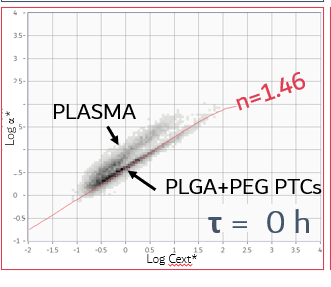 The particles can be fully separated from the plasma particles thanks to their different refractive indices and the optical capabilities provided by SPES.
Particle mixtures in pigments, inks and industrial dispersions
Pigments and inks contain dispersed particles together with formulation additives, and different pigment materials may coexist in the same product. Industrial dispersions can also include abrasives, polymer particles, droplets or process contaminants.
Separating populations analytically allows each component to be evaluated for particle size and concentration. This can support formulation optimization, raw-material comparison and Quality Control.
Oversize analysis can add another layer of control by identifying particles above a selected threshold within the complete sample or within a specific population.
Environmental and biological heterogeneous samples
Environmental particle analysis frequently involves complex matrices rather than purified suspensions. Microplastics may coexist with minerals, black carbon and natural particulate matter. Biological fluids may contain many endogenous components in addition to the particles being studied.
Optical classification can help distinguish a target population from the surrounding background when the particles have different optical properties. This supports direct measurements in complex samples and can reduce the analytical uncertainty created by a global response.
Population-specific numerical concentration is particularly useful when the objective is to quantify the target component rather than the total particulate content of the fluid.
How Classizer™ ONE analyses heterogeneous particle populations
Classizer™ ONE uses patented SPES technologies to measure individual particles in liquid samples. Each validated particle contributes multiple optical parameters rather than a single bulk intensity value.
The Classizer™ Software Platform converts these measurements into EOS CLOUDS and provides tools for selecting individual populations. Absolute Particle Size Distribution, numerical concentration and effective refractive index can then be retrieved for the whole sample or for selected populations.
Advanced analysis can also support structural studies, oversize evaluation, continuous-flow measurements and statistical comparison, depending on the configuration and analytical workflow.
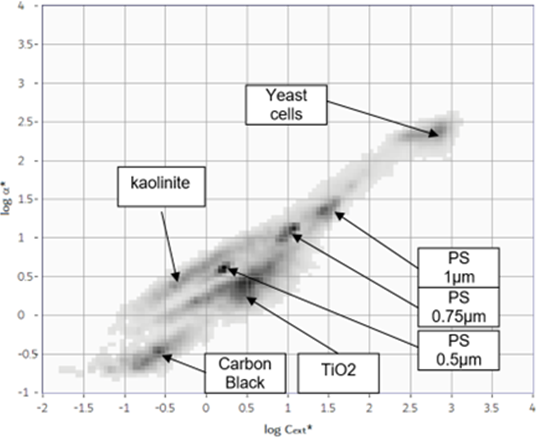
Figure 3: A real sample showcases the capabilities of SPES is discerning different sub-populations in a complex kixture: yeast cells, kaolinite, polystyrene of different sizes (1, 0.75, 0.5 um), TiO2 and Carbon black are all fully resolved from each other, allowing to retrieve the PSD of each subpopulation with a few click from the user.
Batch-to-batch comparison of complex mixtures
Quality Control of heterogeneous products requires more than checking a global average. Two batches can have similar overall particle size distributions while differing in the relative abundance or properties of individual components.
Population-specific analysis makes these differences easier to detect. Reference batches can be compared with production samples using particle size, concentration, optical parameters and oversize information.
Principal Component Analysis can further support batch comparison by reducing complex multiparametric datasets and identifying samples that cluster with, or deviate from, established reference groups.
Choosing an analytical method for heterogeneous particles
The appropriate method depends on the complexity of the sample and the information required. Microscopy provides direct images and morphological detail. Chemical or spectroscopic techniques can identify composition. Laser diffraction and Dynamic Light Scattering provide valuable size information for suitable systems.
When several populations overlap in size, an additional classification parameter becomes important. Single-particle optical measurements can provide this discrimination while also retaining particle size and concentration information.
In many research and industrial workflows, the strongest characterization strategy combines complementary techniques rather than relying on one instrument for every question.
Frequently asked questions about heterogeneous particle analysis
What makes a particle sample heterogeneous? A sample is heterogeneous when it contains populations that differ in material, size, optical properties, structure or other relevant characteristics.
Can particles with the same size be separated analytically? Yes, if they differ in another measurable parameter. SPES uses optical properties and effective refractive index to distinguish populations that may overlap in size.
Can concentration be measured for each population? When populations can be classified separately, numerical concentration can be calculated for the selected component.
Why not simply filter the sample first? Filtration or purification can be useful, but it may remove information or alter the sample. Direct classification can be advantageous when the target population can be distinguished within the original fluid.
Is heterogeneous particle analysis useful for Quality Control? Yes. It can reveal changes in individual components that would be hidden in a global particle size distribution.
Beyond a single particle size distribution
Real particle systems are often mixtures. Treating them as one homogeneous population can hide information that is important for formulation development, process optimization, environmental studies and Quality Control.
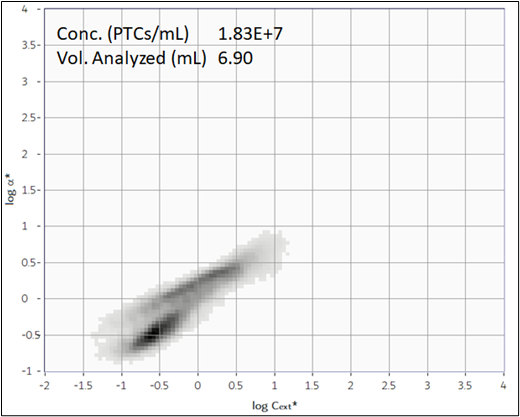
Figure 4: quality control of inks and pigments can benefit from SPES data, that can separate with confidence different populations allowing to study effectively the behaviours of different components within a complex matrix.
SPES-based multiparametric analysis provides a way to classify individual particles according to their optical properties and analyse distinct populations within the same sample.
By combining particle size, numerical concentration, effective refractive index and population-specific analysis, Classizer™ ONE provides a more complete description of heterogeneous particle mixtures than a one-dimensional size distribution alone.
Related posts
