

Particle Aggregation Analysis
Particle stability is one of the most critical parameters governing the performance, safety and quality of modern formulations. Whether a system consists of pharmaceutical suspensions, protein therapeutics, emulsions, colloidal dispersions, nanoparticles or advanced functional materials, the behaviour of particles over time directly influences product efficacy, shelf life and manufacturing consistency. Particle stability analysis therefore extends far beyond a simple laboratory measurement: it provides a comprehensive understanding of how particulate systems evolve throughout development, production, storage and final use. By studying formulation stability together with particle stability monitoring, scientists can identify early changes that precede visible degradation, allowing corrective actions before product performance is compromised. This approach is increasingly adopted in pharmaceutical, biotechnology, food, cosmetic and specialty chemical industries, where even subtle changes in particle behaviour may affect regulatory compliance and commercial success.
What is Particle Stability Analysis?
Particle stability analysis is the systematic evaluation of the physical evolution of particles suspended or dispersed within a medium. Rather than focusing exclusively on particle size, it investigates how particles interact with each other, respond to environmental conditions and maintain their original characteristics over time. Temperature, pH, ionic strength, concentration, mechanical stress and storage conditions can all influence particle behaviour. Monitoring these variables provides valuable information about formulation stability and supports the design of more robust products with predictable long-term performance.
Colloidal Stability Analysis
Colloidal stability analysis is particularly important when particles are sufficiently small for interparticle forces to dominate their behaviour. Attractive and repulsive interactions continuously compete within a dispersion, determining whether particles remain uniformly distributed or gradually aggregate into larger structures. Understanding colloidal stability allows researchers to optimise stabilising agents, surfactants and formulation parameters while reducing aggregation, sedimentation or phase separation. Instead of relying solely on visual inspection, advanced optical techniques reveal microscopic changes long before macroscopic instability becomes evident, making colloidal stability analysis an essential component of formulation development.
Formulation Stability
Formulation stability encompasses the complete behaviour of a product throughout its intended lifetime. A stable formulation preserves its particle size distribution, concentration, morphology and optical characteristics despite storage or transportation. In pharmaceutical products this directly affects dose uniformity, bioavailability and patient safety, while in cosmetics, food and industrial formulations it determines appearance, texture and functional performance. Comprehensive particle stability analysis therefore provides a scientific basis for selecting excipients, defining manufacturing parameters and establishing realistic shelf-life specifications.
Particle Degradation
Particle degradation may occur gradually through physical or chemical mechanisms. Aggregation, flocculation, coalescence, dissolution, Ostwald ripening and structural collapse may alter the original particle population, producing changes that influence performance even when they remain invisible to the naked eye. Environmental factors such as temperature fluctuations, oxidation, light exposure or repeated freeze-thaw cycles may accelerate these processes. Continuous particle stability monitoring allows laboratories to detect these changes early, supporting proactive quality control and reducing the risk of product failure.
Advantages of SPES in measuring particle stability
For monitoring short-term physical stability, SPES with the Classizer™ ONE offers a qualitative advantage that no single-observable technique can match: because each measurement produces a two-dimensional portrait of the sample — every particle placed in size-versus-refractive-index space — you can detect the very earliest stages of aggregation before they register as anything meaningful in a conventional size distribution. With laser diffraction or DLS, the first sign of aggregation is typically a subtle broadening of the distribution or a shift in the Z-average, changes that only become statistically unambiguous once a significant volume fraction has aggregated. SPES instead counts individual particles, so the appearance of even a small sub-population of objects with depressed refractive index — the optical fingerprint of partially hydrated, solvent-infiltrated aggregates — is directly visible as a new cluster in the 2D map from the very first time point at which it exists. As the sample evolves, you can track that population independently: how its number grows, whether aggregate size increases, and whether the RI continues to drop (indicating increasingly open, porous structures) or stabilizes. This makes SPES unusually sensitive as an early-warning tool, capable of flagging instability at time points where other methods would still report a clean, apparently monomodal distribution.
The same capability becomes equally powerful when the goal is not monitoring but optimization — screening formulation conditions, excipients, pH, or ionic strength to find a stable operating window. In a conventional workflow, you vary a formulation parameter, stress the sample, then run DLS or LD to see whether the size distribution shifted; the feedback is binary and lagged. With SPES, each formulation condition you test returns not just a size distribution but a compositional map: you can see whether a given buffer pH suppresses aggregation entirely, or merely slows it while producing compact aggregates with near-primary-particle RI, or produces a loose, highly porous aggregate population with strongly depressed RI — three physically distinct outcomes that carry very different implications for downstream stability, bioavailability, or immunogenicity, but that would be indistinguishable by size alone. For process optimization contexts — milling cycles, homogenization passes, lyophilization cycles — this means each process step can be characterized not just by whether the particles got smaller or larger, but by whether their internal structure and composition changed, giving formulation scientists a far richer feedback signal to optimize against.
Particle Stability Monitoring
Particle stability monitoring is not limited to final quality control but accompanies the entire product lifecycle. During research it assists formulation screening, during scale-up it verifies process reproducibility, and during manufacturing it confirms batch-to-batch consistency. Long-term monitoring performed under real-time and accelerated storage conditions generates valuable datasets describing how formulations evolve. These data support regulatory documentation, process optimisation and continuous improvement while providing confidence that products will maintain their intended characteristics until the end of their shelf life.
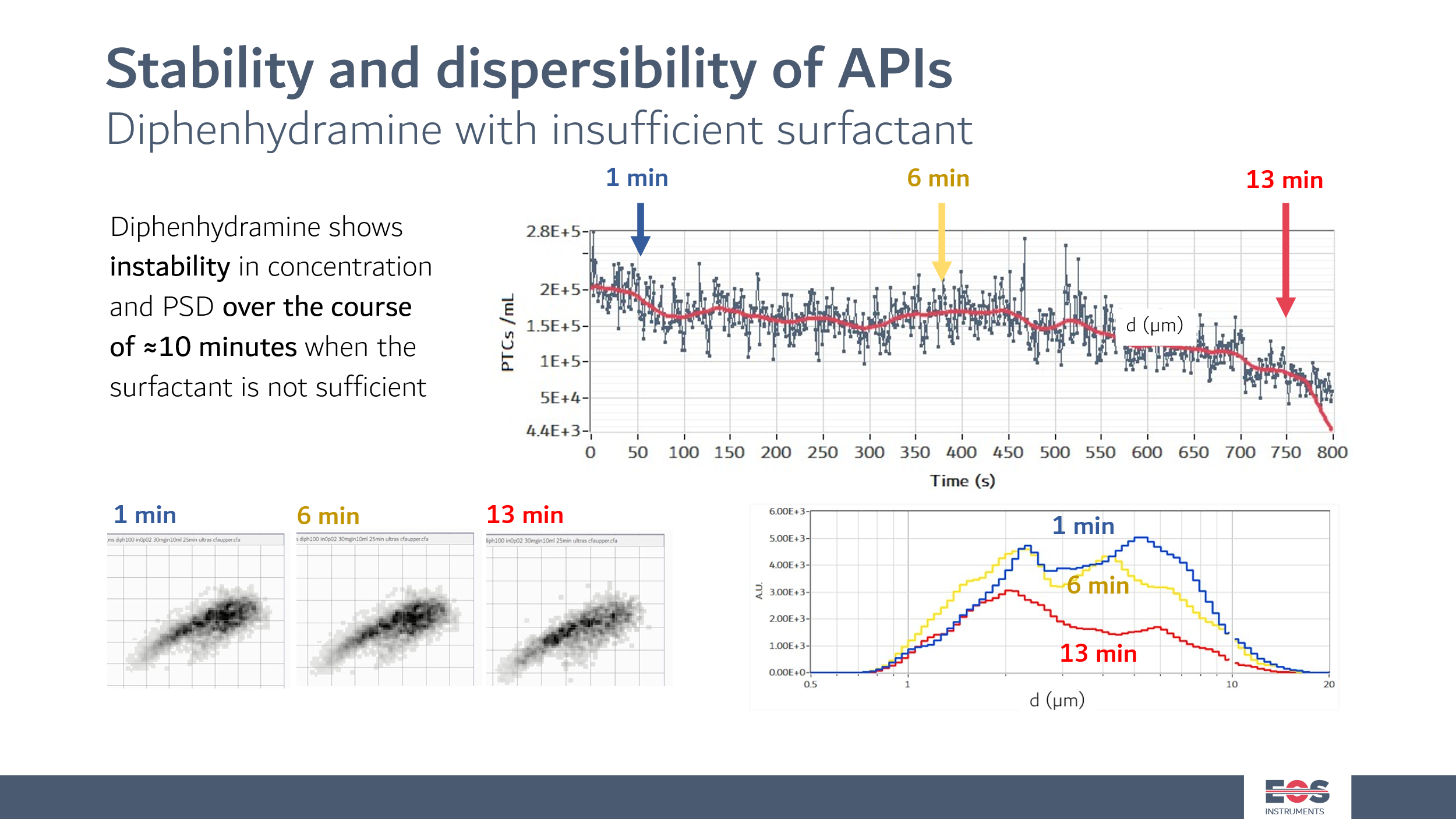
Figure 1: particle stability studied by SPES, where over approx. 10 minutes this API, dispersed in a solvent with insufficient surfactant, is not stable in concentration and PSD.
Applications
Particle stability analysis plays a central role across numerous industries. Pharmaceutical laboratories evaluate injectable formulations, biologics, vaccines and nanoparticle-based drug delivery systems to ensure consistent therapeutic performance. Biotechnology companies investigate protein formulations and complex biological suspensions where aggregation directly influences efficacy. Cosmetic manufacturers study creams, lotions and emulsions to preserve appearance and sensory properties, while food scientists analyse beverage dispersions, emulsions and encapsulated ingredients to improve texture and stability. Materials science and specialty chemical industries employ colloidal stability analysis to optimise pigments, coatings, ceramic suspensions and advanced functional materials, demonstrating the broad relevance of formulation stability across modern manufacturing.

Figure 2: the long-term stability of a cream containing ZnO is studied over time.
SPES allows to distinguish droplets of pure lipid, that forms in salt water but not in demineralized water, from droplets containing the lipid and the zinc.
Reliable particle stability analysis provides a comprehensive understanding of how particulate systems behave throughout their entire lifecycle. By integrating colloidal stability analysis, formulation stability studies, particle degradation assessment and continuous particle stability monitoring, researchers obtain a multidimensional view of product quality that extends well beyond conventional particle sizing. This knowledge supports scientific innovation, strengthens quality assurance and contributes to the development of stable, reproducible and high-performing formulations across pharmaceutical, biotechnology and advanced industrial applications.
Related posts


