

Particle Stability Analysis
Particle aggregation analysis is a critical part of advanced particle characterization, especially in applications where formulation stability, product performance, and quality control depend on the ability to detect and understand particle clusters over time. Aggregation can occur in many different systems, including pharmaceutical formulations, protein dispersions, liposomes, emulsions, colloids, pigments, inks, biological fluids, and industrial suspensions.
For example, slurries for the semiconductor industry are systems with often a very small fraction of aggregates of the main populations, yet the characterization of the aggregate
part is crucial in quality control. Even when the primary particle size distribution appears acceptable, the presence of aggregates or flocs can strongly influence the behaviour of the final product.
In practical terms, particle aggregation occurs when individual particles interact and form larger structures.
These structures may be loose and reversible, as in some flocculation processes, or more compact and persistent, as in stable aggregates. The analytical challenge is not only to detect that aggregation is happening, but also to understand how it affects particle size distribution, concentration, optical behaviour, formulation stability, and long-term product quality.
For companies developing complex formulations, aggregation is rarely a minor detail. It can change viscosity, sedimentation, appearance, efficacy, safety, and batch-to-batch reproducibility. This is particularly important in pharmaceutical and biotech environments, where aggregation may affect drug delivery performance, biological activity, or product acceptability. Or for example, the quality and performance of a paint or coating might depend on particles aggregates. Advanced particle aggregation analysis therefore
supports both formulation development and troubleshooting activities, helping laboratories identify the source of instability before it becomes a quality or performance issue.
Why Particle Aggregation Matters
Particle aggregation can directly affect the physical, chemical, and biological behaviour of a product. In colloidal dispersions and emulsions, aggregates may indicate instability, poor formulation design, or sensitivity to storage conditions. In pharmaceutical systems, aggregation may influence release kinetics, bioavailability, immunogenicity, or the ability of a formulation to remain stable during its intended shelf life. In industrial applications such as pigments, inks, coatings, and abrasives, aggregation may affect colour consistency, optical properties, texture, flow behaviour, and processability.
Aggregation is also important because it may develop gradually. A formulation that appears stable immediately after production may start forming particle clusters after changes in temperature, pH, ionic strength, mechanical stress, or storage time. If these early aggregation phenomena are not detected, they may lead to sedimentation, phase separation, oversize formation, or loss of product performance. For this reason, particle aggregation measurement is essential not only for final quality control, but also for stability
studies and process optimization.
Aggregate characterization helps researchers distinguish between primary particles, secondary particle populations, and larger clusters. This distinction is important because a simple average particle size value may not reveal whether the sample contains a small but significant population of aggregates. In many applications, the presence of even a limited number of oversized or aggregated particles can be more relevant than the average size of the main population. Advanced analytical methods must therefore provide
enough resolution to identify and characterize these minority populations.
Challenges of Conventional Aggregation Measurement
Traditional particle analysis methods often struggle when aggregates are present in heterogeneous or polydisperse samples. Dynamic Light Scattering (DLS), for example, is highly sensitive to larger particles because scattering intensity increases strongly with particle size. As a result, even a small number of aggregates may dominate the signal and distort the interpretation of the whole sample. This can make it difficult to distinguish between a real shift in the main particle population and the appearance of a secondary
aggregated population.
Bulk measurement techniques may also collapse complex sample information into a single average value or a simplified distribution. This can hide important details related to aggregate formation, flocculation, or structural differences between particle populations. When multiple populations coexist, conventional methods may not provide enough information to identify which particles are primary, which are aggregated, and how each population contributes to the overall behaviour of the formulation.
Laser diffraction instruments like the Mastersizer are widely used for particle size analysis, but they have a fundamental blind spot when it comes to aggregates. Because they measure the collective scattering pattern of millions of particles simultaneously and assume all of them are perfect spheres with uniform refractive index, they reduce the entire sample to a single “equivalent sphere” size distribution — a model that breaks
down completely for the irregular, porous, composite structures that aggregates actually are. Compounding this, scattering intensity scales steeply with particle size, so even a tiny number of large aggregates can dominate the signal and mask what’s happening with the primary particles underneath. The result is that laser diffraction can hint that aggregation is occurring — a shoulder appears, the distribution broadens — but it cannot tell you how many aggregates are present, what size they truly are, or how they relate to the
primary particle population. Single-particle methods that measure each particle individually sidestep this entirely: instead of inverting a blurred ensemble average, they count and characterize every particle on its own terms, making even rare aggregation events directly visible in the data rather than statistically buried.
SPOS, Single-particle optical sizing is a laser diffraction technology used aggregate detection: because it measures particles one at a time, even rare large aggregates are counted explicitly rather than buried in an ensemble average, making it suited for quantifying oversize tails in otherwise fine distributions — which is exactly why it has found a home in pharmaceutical subvisible particle testing. The limitation is that it only
measures how much light a particle blocks, which means it is completely blind below roughly 1–2 µm, it cannot distinguish a compact aggregate from a solid sphere of identical cross-section, and low-RI or transparent particles produce weak signals that lead to undersizing or missed events altogether.
The Coulter counter has the advantage of measuring displaced volume directly, with no optical model and no refractive index assumption — on paper the most physically rigorous single-particle size measurement available. For aggregates, however, this is double-edged: what it actually measures is the volume of electrolyte displaced, which for a porous or open aggregate includes all the solvent trapped inside the structure, inflating the apparent size in a way that depends on aggregate morphology and cannot be corrected without independent structural information. Worse, the measurement requires a conductive electrolyte carrier, which can alter ionic strength and directly perturb the very aggregation state you are trying to characterize — a fundamental conflict of interest when aggregation is the analyte. This can be particularly problematic with slurries for the semiconductor industry and colloidal systems overall, where the surface charge and ionic strengths play a fundamental role in particle stability.
Another challenge is that aggregates may differ not only in size but also in compactness, shape, refractive index, and optical response. Two aggregates with similar dimensions may behave very differently if one is a loose floc and the other is a compact cluster. A method based only on particle size may therefore be insufficient to understand the real structure and stability of the system. Effective particle aggregation analysis requires multiparametric information that can connect size, optical properties, and population
behaviour.
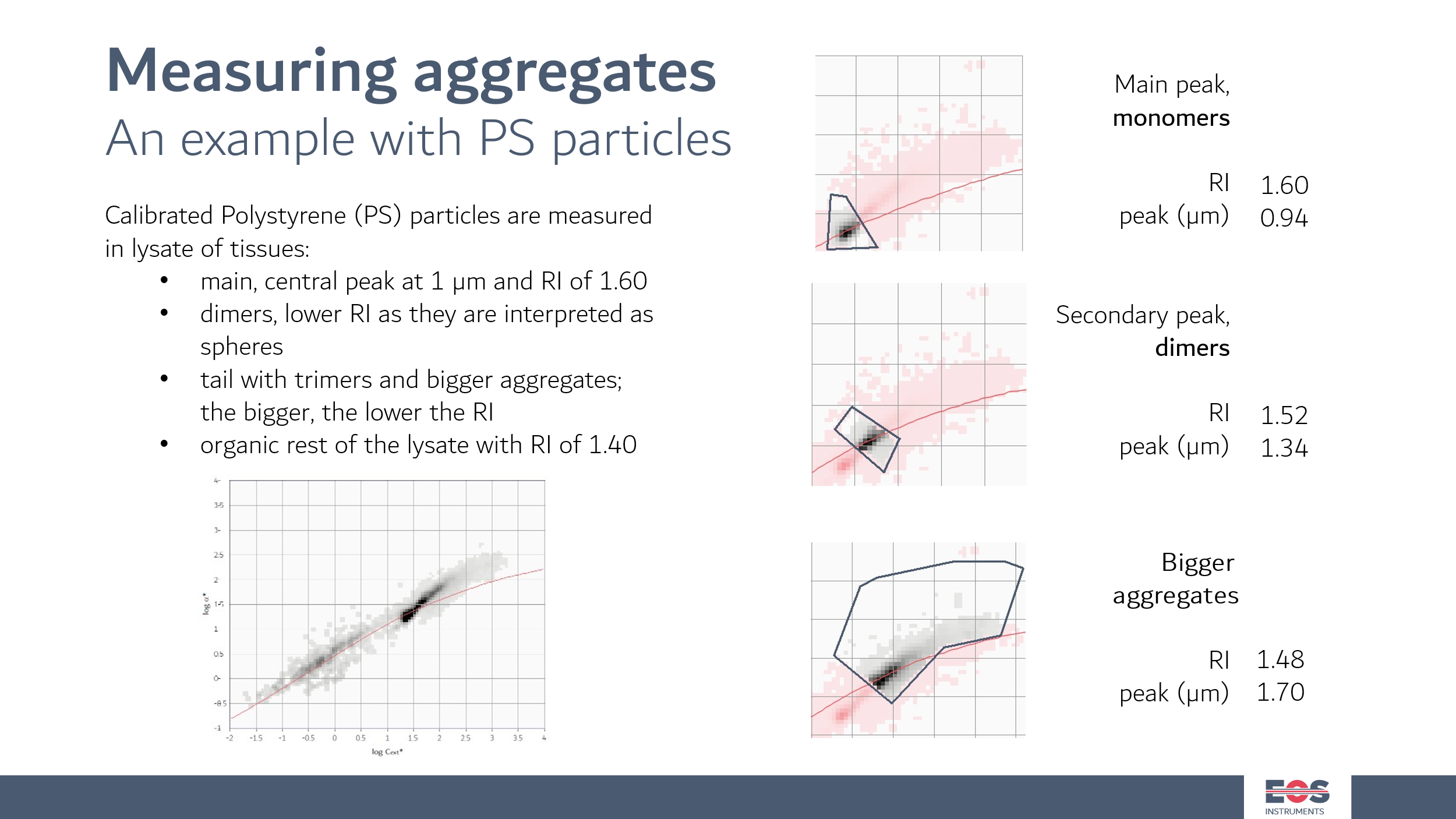
Figure 1: An example of measuring real polystyrene particles samples with SPES: monomers, dimers and bigger aggregates have lower and lower refractive indeces, which SPES can measure and quantify. Using the correct refractive index, the size of the aggregate is derived.
SPES Technology for Particle Aggregation Analysis
SPES technology by EOS Instruments, available in the Classizer™ ONE particle analyzer, supports advanced particle aggregation analysis through multiparametric single-particle optical characterization. By measuring individual particles and retrieving optical information from extinction and scattering signals, SPES technology can provide insight into particle populations that may be difficult to resolve with conventional bulk methods. This is particularly valuable when aggregation occurs within heterogeneous samples or when aggregated particles coexist with primary populations.
Beyond counting, however, SPES collects both the extinction cross-section and the scattering cross-section for each particle simultaneously, which means it can extract the refractive index at the single-particle level. For aggregates this is unusually informative: an aggregate has a lower effective refractive index than its constituent primary particles because its internal volume is partially occupied by solvent, and the difference in RI between aggregates and bulk reflects packing density and structure. In principle this allows SPES to not only detect and size aggregates, but to flag them as optically distinct from primary particles in the same measurement — something no obscuration or electrical sensing method can do.
The ability to analyze particles one by one allows SPES technology to identify distinct particle populations based on their optical fingerprint. Aggregates, flocs, and clusters may generate different EOS CLOUDS distributions compared to well-dispersed primary particles, enabling analysts to select, compare, and quantify populations independently. This makes it possible to move beyond the simple question of whether particles are larger, and instead investigate how aggregation modifies the optical and structural behaviour of the sample.
Effective refractive index information is especially useful in aggregate characterization. Aggregation can change the apparent optical properties of a particle population because compactness, porosity, and internal structure influence the way light interacts with the particle system. SPES technology can help detect these differences and support a more detailed interpretation of aggregation phenomena. This makes it a strong analytical tool for formulations where stability, particle behaviour, and structural evolution are critical.
Applications in Pharma, Biotech, and Formulation Development
Particle aggregation analysis is highly relevant in pharmaceutical and biotech applications. Protein formulations, lipid nanoparticles, liposomes, emulsions, and controlled-release systems may all be affected by aggregation or flocculation. In these contexts, aggregate formation can compromise formulation stability, reduce reproducibility, or indicate degradation mechanisms that require deeper investigation. Advanced aggregate characterization supports formulation development by helping researchers identify instability pathways and optimize composition, process conditions, and storage protocols.
In biotech and biological fluids, aggregates may appear in complex matrices where background particles, proteins, vesicles, or cellular debris are also present. This makes analysis especially challenging because the sample may contain multiple particle populations with different sizes and optical properties. SPES technology can support the investigation of these heterogeneous systems by helping distinguish particle populations and identify aggregation-related changes.
In industrial formulation development, aggregation analysis is equally important. Pigments, inks, coatings, emulsions, food dispersions, and personal care products must maintain stable particle distributions to preserve performance and appearance. Particle aggregation measurement can help identify early signs of instability, support batch-to-batch comparison, and improve product quality control. By detecting aggregate formation and linking it to particle behaviour, laboratories can make more informed formulation and manufacturing decisions.
Particle Stability and Aggregation Analysis
Particle aggregation is closely linked to particle stability analysis. A stable dispersion maintains its particle populations over time, while an unstable system may show aggregation, flocculation, sedimentation, coalescence, or oversize formation. Monitoring these changes is essential for understanding shelf life, formulation robustness, and process reliability. In this sense, particle aggregation analysis is not only a diagnostic measurement, but also a way to evaluate long-term formulation behaviour.
Flocculation analysis is particularly important when particles form loose, reversible clusters rather than compact aggregates. Flocs may influence viscosity, sedimentation, filtration, and performance even if they can be partially redispersed. Understanding whether a sample contains primary particles, reversible flocs, or more stable aggregates helps researchers evaluate the real state of the formulation and choose the correct development or troubleshooting strategy.
Advanced optical particle characterization can provide more meaningful information than size measurement alone. By combining particle size distribution, optical fingerprint, refractive index behaviour, and population mapping, SPES technology supports a more complete understanding of how aggregation and flocculation affect complex particle systems. This makes the analysis more useful for both R&D and quality control workflows.
Particle aggregation analysis is essential for understanding the stability and behaviour of complex particle systems. Aggregates, clusters, and flocs can strongly affect formulation performance, product quality, and analytical reproducibility, even when they represent only a small fraction of the total sample. Detecting and characterizing these populations requires more than a simple average particle size measurement.
SPES technology by EOS Instruments provides advanced multiparametric single-particle analysis that can support aggregate characterization, particle stability analysis, and flocculation studies in complex samples. By combining optical fingerprinting, particle population discrimination, and high-resolution analysis, SPES technology helps laboratories obtain deeper and more actionable information about aggregation phenomena.
For pharmaceutical, biotech, industrial, and formulation development workflows, this approach can improve troubleshooting, support quality control, and guide more reliable product development decisions.
Related posts


