Environmental particle analysis is becoming increasingly important for understanding air quality, water quality, climate change and ecosystem health. Atmospheric aerosols, mineral dust, engineered nanoparticles and naturally occurring particulates interact with biological systems and influence radiative transfer, pollutant transport and environmental toxicity. Accurate characterization of particle size distribution, concentration, refractive index and optical properties is therefore essential for environmental monitoring, ecotoxicology and climate research.

Classizer™ ONE, based on the patented SPES technology, performs advanced single-particle characterization in heterogeneous environmental samples, supporting research laboratories and environmental monitoring programmes with rapid, multiparametric analysis.
The case of Lipid/ZnO Emulsion in Environmental Waters
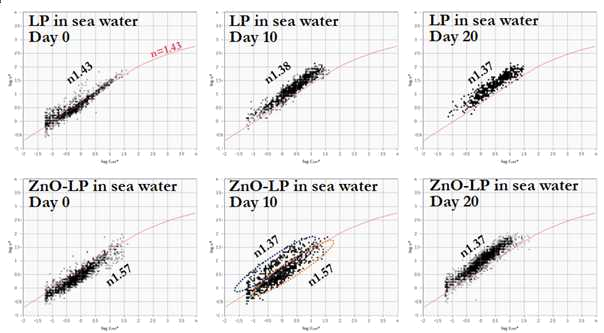
Zinc oxide nanoparticles are widely used in coatings, pigments, plastics, cosmetics and industrial formulations, making their environmental fate an important research topic. In this application, ZnO particles encapsulated within lipid droplets are dispersed in different natural waters to evaluate ageing processes under realistic environmental conditions. Classizer™ ONE continuously characterizes particle size distribution, effective refractive index and optical behaviour during incubation, allowing researchers to compare the stability and transformation of particle populations in ultrapure water, reservoir water, seawater and peat bog water. This multiparametric approach provides valuable insight into nanoparticle transport, persistence and environmental impact.
Check out the full data in our Application Note.

Evolution of lipid particles (LP) and of a ZnO-lipid particles emulsion in sea water at three time steps: day 0, day 10, day 20. Red line corresponds to the expected Mie curve for n = 1.43, reported here as a guide to the eye.
The case of dust in glacial waters
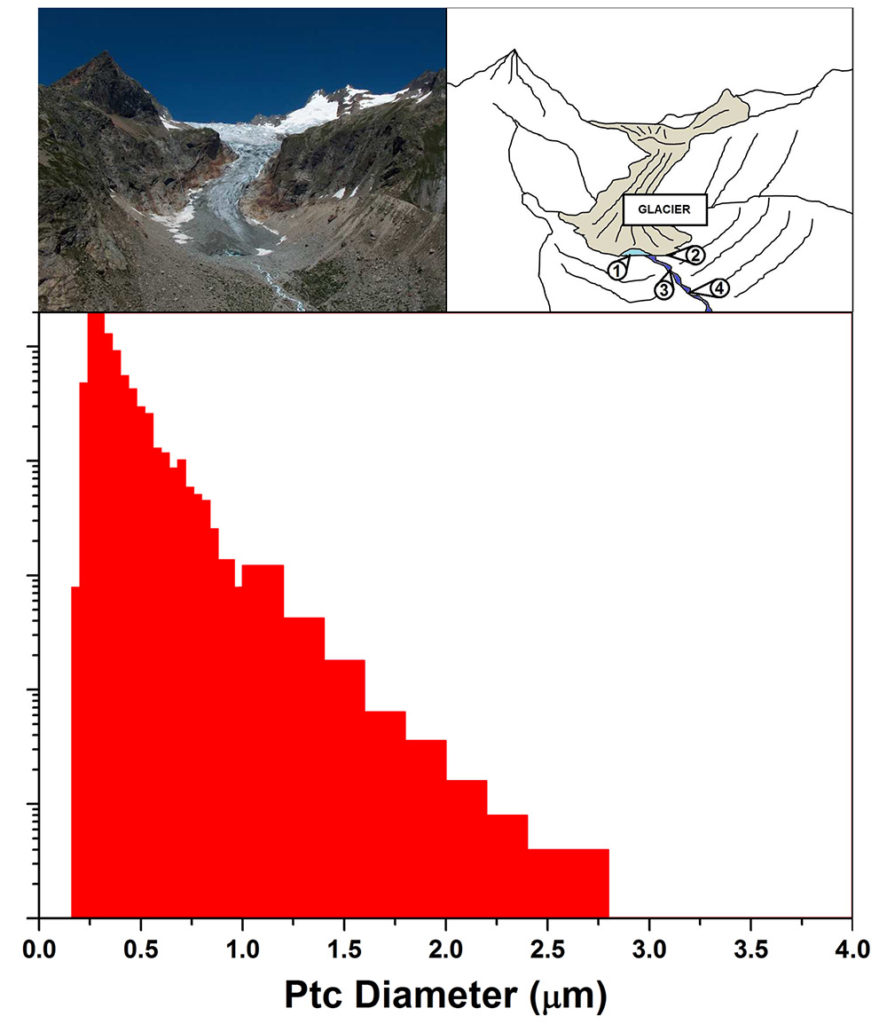
Mineral dust transported into alpine and glacial environments affects atmospheric optics, glacier melting and climate modelling. Because natural dust particles are highly irregular, conventional techniques based on spherical assumptions often provide incomplete information.

Classizer™ ONE directly measures the optical properties and extinction cross section of individual particles while providing information about particle size distribution and particle shape. The resulting data improve the characterization of environmental dust, support radiative transfer models and contribute to more reliable climate and environmental studies involving natural particulate matter.