Accurate particle analysis in heterogeneous biological fluids such as serum, plasma, urine and cell lysates remains challenging for conventional light scattering methods including DLS, SLS, NTA and Light Obscuration.
SPES technology enables true single-particle characterization directly in complex biological media, supporting drug delivery studies, nanoparticle analysis and eco-/cytotoxicity investigations.
(In figure) (Top)
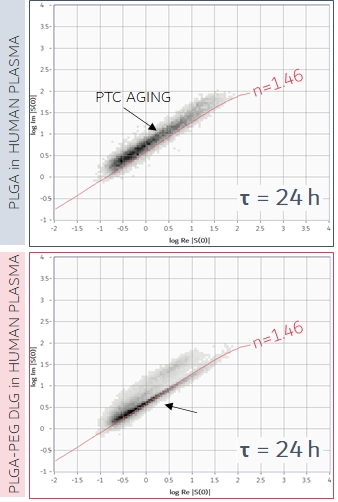
EOS CLOUDS maps demonstrate optical fingerprint changes of PLGA particles after incubation in human plasma, highlighting ageing effects and PEG stabilization.
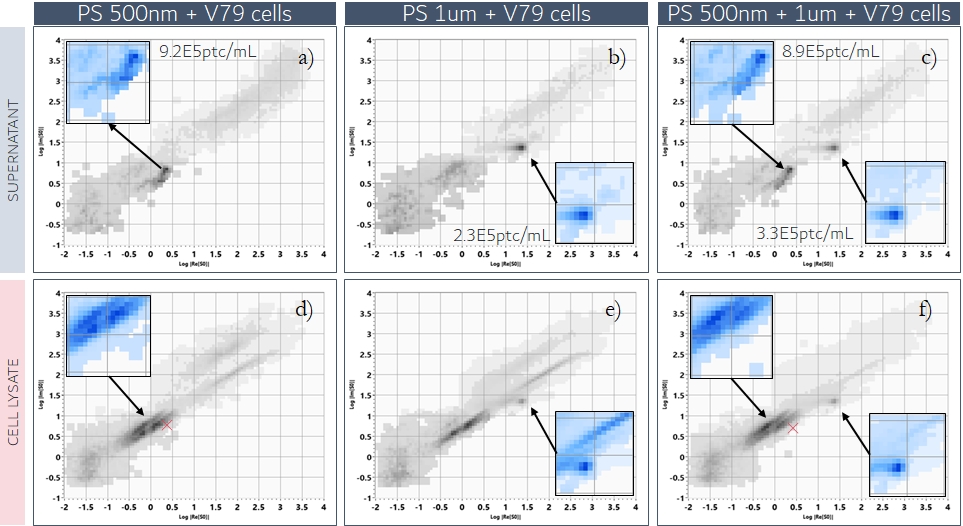
(In figure) EOS CLOUDS distinguish particle populations in supernatants and cell lysates, revealing biological interactions through changes in optical properties.