Polymeric particle dispersions are widely used across pharmaceutical, personal care, food, pigments, inks, ceramics, and advanced material applications. Maintaining stable and well-dispersed particle systems is essential to prevent aggregation, sedimentation, oversize formation, and long-term product instability.
The Classizer™ particle analyser, based on the patented SPES technology by EOS Instruments, introduces an advanced approach to single-particle optical characterization. By combining extinction and scattering measurements, SPES technology enables accurate identification and analysis of different particle populations throughout formulation development, process optimization, and final product quality control.
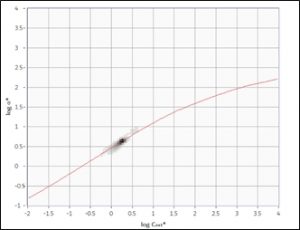
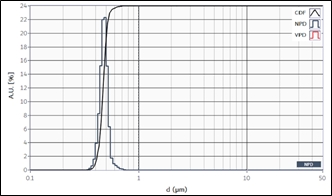
The figures show the high-resolution characterization capabilities of SPES technology applied to 0.5 μm polystyrene particles dispersed in filtered water. Thousands of validated particles populate the EOS CLOUDS map, generating a precise optical fingerprint used for quantitative particle analysis.
The particle cloud distribution reflects relative particle concentration and optical behavior, while the numerical particle size distribution confirms the accuracy and reproducibility of the Classizer™ ONE system. The measured average particle diameter and refractive index demonstrate the capability of SPES technology to provide reliable and calibration-free particle characterization.
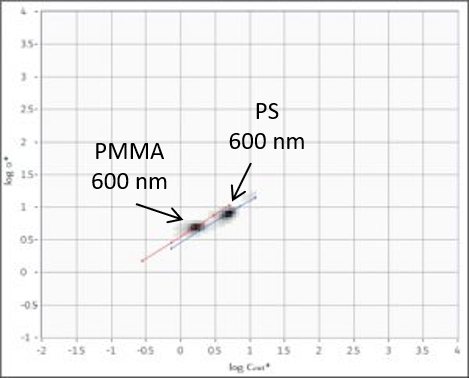
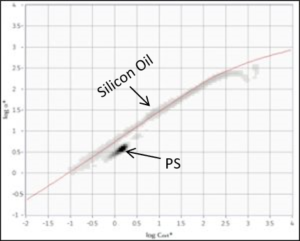
The figures demonstrate the capability of SPES technology to resolve and characterize heterogeneous particle systems containing multiple particle populations.
In the first example, PMMA and PS submicron particles generate two clearly separated EOS CLOUDS distributions, allowing independent analysis of particle concentration and optical properties for each population. In the second example, silicon oil emulsions and polystyrene tracer particles are simultaneously detected and distinguished, confirming the effectiveness of SPES technology for complex multiphase and heterogeneous fluid analysis.